Chipmakers Get Paid. When Will Big Tech Break Even?
Big Tech is paying to build AI infrastructure while chipmakers book the revenue first. This article traces that cash-flow chain and identifies four signals that would confirm the cycle has turned.
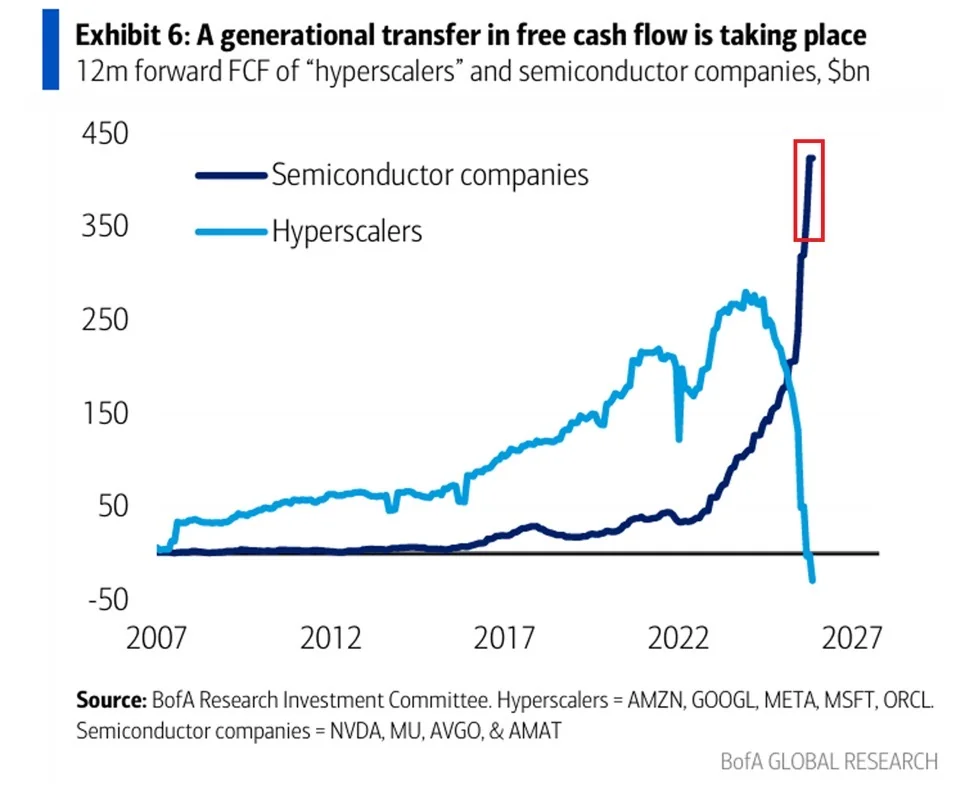
Chipmakers' free cash flow looks so strong because the tech giants are spending so heavily.
A recent Bank of America chart projects that NVIDIA, Micron, Broadcom, and Applied Materials will generate more than $400 billion in combined free cash flow over the next 12 months, while the combined figure for Amazon, Alphabet, Meta, Microsoft, and Oracle falls below zero. The market calls it a "generational transfer in free cash flow." I see a payment chain that is still running: the tech giants spend first to build AI infrastructure, and the chipmakers get paid first. It is also a chain of dependency. How long it lasts depends on whether the tech giants can turn that infrastructure into enough cash return.
The AI capital expenditure cycle is still in its buildout phase and has not peaked. The price cycle in semiconductor stocks may already have turned weaker.
When Free Cash Flow Falls, Follow the Money
Amazon's trailing 12-month free cash flow fell from $25.9 billion to $1.2 billion, as purchases of property and equipment increased by $59.3 billion year over year, mainly because of AI investment. Over the same period, AWS revenue grew 28% to $37.6 billion and operating income rose to $14.2 billion. Cash flow has nearly disappeared while AWS revenue and profit are accelerating. The cash is being used to pay construction costs in advance.
Microsoft spent $31.9 billion on capital expenditure in its latest quarter and still generated $15.8 billion in free cash flow. Azure revenue grew 40%, and management said customer demand continued to exceed available capacity. The company expects roughly $190 billion in capital expenditure during calendar 2026. Much of that money will become GPUs, CPUs, networking equipment, and data centers. Chipmakers recognize revenue when they deliver. Microsoft has to recover the cost through years of future cloud and AI revenue.
The negative figure in the Bank of America chart is a combined 12-month forward estimate for the five hyperscalers. It does not mean that all five are currently reporting negative free cash flow. Looking at one free-cash-flow line can turn an investment phase into an apparent business failure. Where the capital went, whether customers use the capacity, and whether they pay for it matter far more than the direction of free cash flow alone.
AI Is Already Generating Revenue
Microsoft's AI business has passed $37 billion in annual recurring revenue, up 123% year over year. Google Cloud's latest quarterly revenue rose 48% to $17.7 billion, backlog reached $240 billion, and operating margin hit 30.1%. Oracle's remaining performance obligations rose to $638 billion, with most of the increase coming from large AI contracts; some customers prepaid for GPUs or supplied the hardware themselves. Broadcom's AI semiconductor revenue rose 143% to $10.8 billion, with the next quarter expected to reach $16 billion.
AI has moved into revenue, contracts, and real cash transactions. The question is how much capital it takes to produce one additional dollar of AI revenue. If incremental cash flow can cover depreciation, electricity, and financing costs, today's negative free cash flow is simply the investment phase. If revenue cannot keep up with those costs, the buildout becomes a capital burden.
Enterprise customers are already paying for AI. Orders and revenue are strong enough to keep the buildout moving, and the AI capital expenditure cycle has not peaked. But the market still does not know whether the tech giants will earn back what they are spending.
If Capital Expenditure Slows, Ask Why
Capital expenditure will eventually slow. What matters is whether that happens after revenue and utilization rise, or after demand and orders weaken.
If infrastructure comes online, customer revenue and operating profit keep growing, and spending falls after construction is completed, that is harvest. If demand weakens first, projects are delayed, orders are canceled, and companies cut spending afterward, that is retreat. Both paths reduce capital expenditure. Their implications are opposite.
AWS has already demonstrated the successful path: after infrastructure entered service at scale, revenue and operating profit continued to grow, and a slower pace of capital expenditure could release free cash flow. The telecom networks of the dot-com era demonstrated the other path. The internet was real technology and fiber changed the world, but infrastructure investment ran far ahead of actual demand. Financing tightened, capacity became excessive, and revenue failed to materialize. The equipment suppliers that booked enormous revenue first were later hit first when orders collapsed. Getting the technology right never guarantees that every capital expenditure cycle will make money.
How I Judge the Cycle Now
Fundamentally bullish, tactically cautious. There is no contradiction. Industry cycles and share-price cycles do not turn on the same day. SOXX's uptrend has been damaged, and memory stocks have come under pressure. The market is shortening the period over which it expects semiconductor profits to remain unusually high. Share prices often turn before orders and financial statements do. Attractive forward free cash flow is not proof that chip stocks have found a bottom. AI is a long-term trend, but price and valuation still matter.
I am watching four groups of signals:
- Whether hyperscalers delay or cancel data-center projects because demand is insufficient;
- Whether AI and cloud revenue and utilization can catch up with depreciation, electricity, and financing costs;
- Whether orders, lead times, prices, and inventories for GPUs, HBM, and networking begin to weaken;
- Whether semiconductor earnings estimates and SOXX's relative performance versus QQQ can stabilize.
If the tech giants cut capital expenditure because demand is weak, AI revenue slows at the same time, and supplier orders and prices deteriorate together, I will accept that the cycle has reversed. When that happens, the chipmakers with the strongest free cash flow today will be hit first.
Until then, I maintain that the AI buildout is not over. I believe AI commercialization will succeed. For now, SOXX remains technically weak. I will not open new positions or add to existing ones until its uptrend is rebuilt; current holdings can remain in place.
Every dollar chipmakers receive today is a bet by the tech giants on tomorrow's demand. When Big Tech earns that money back will determine how long today's semiconductor peak can last.
常見問題 FAQ
Does falling free cash flow at Big Tech mean its AI investment has failed?
No. Amazon's trailing 12-month free cash flow fell from $25.9 billion to $1.2 billion by the first quarter of 2026, while AWS revenue grew 28% to $37.6 billion and operating income rose to $14.2 billion. The test is whether incremental revenue and utilization catch up with depreciation, electricity, and financing costs, not whether one free-cash-flow line is falling.
How can investors tell whether slower AI capital expenditure is harvest or retreat?
Look at demand before the slowdown. If AI and cloud revenue, utilization, and operating profit are still rising, lower spending after the buildout may mark harvest. If projects are delayed, orders are canceled, and supplier pricing and lead times weaken together, it is retreat. Microsoft still said demand exceeded available capacity in its fiscal third quarter of 2026 and expects roughly $190 billion in calendar-year capital expenditure, so the current phase still looks more like construction.
If AI commercialization will succeed, why not add to semiconductor positions now?
The industry cycle and the share-price cycle do not turn together. Bank of America expects NVIDIA, Micron, Broadcom, and Applied Materials to generate more than $400 billion in combined free cash flow over the next 12 months, but strong earnings estimates do not prove that share prices have bottomed. My condition is for SOXX to rebuild its uptrend. Until then, I will not open or add to positions; existing holdings can remain.