The Shovel Seller Tells You Gold Mining Will Make You Rich
A viral post promising '7 AI Skills That Will Make You Filthy Rich' perfectly demonstrates the eighth skill it forgot to mention: how to package thin air as a tutorial and sell it to you. From the California Gold Rush to the Coding Bootcamp bust, shovel sellers always profit more than the miners.
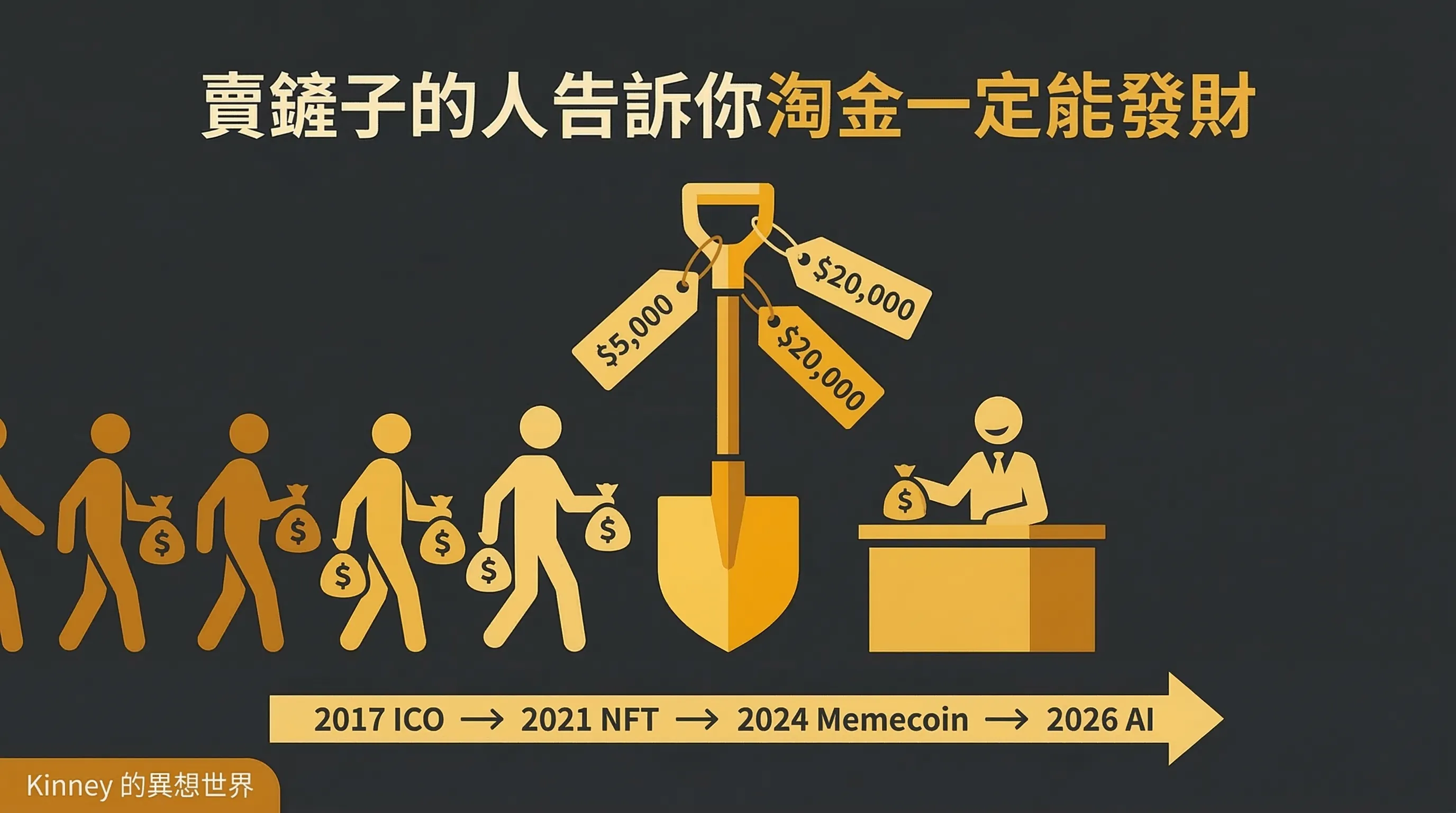
In 1848, gold was discovered at Sutter's Mill in California. The news spread like a plague. Thousands abandoned their families, grabbed their life savings, and stampeded west. They squatted in riverbeds — some for months, some for years. Most came up empty, burying their savings and health in the mud.
But one man got rich.
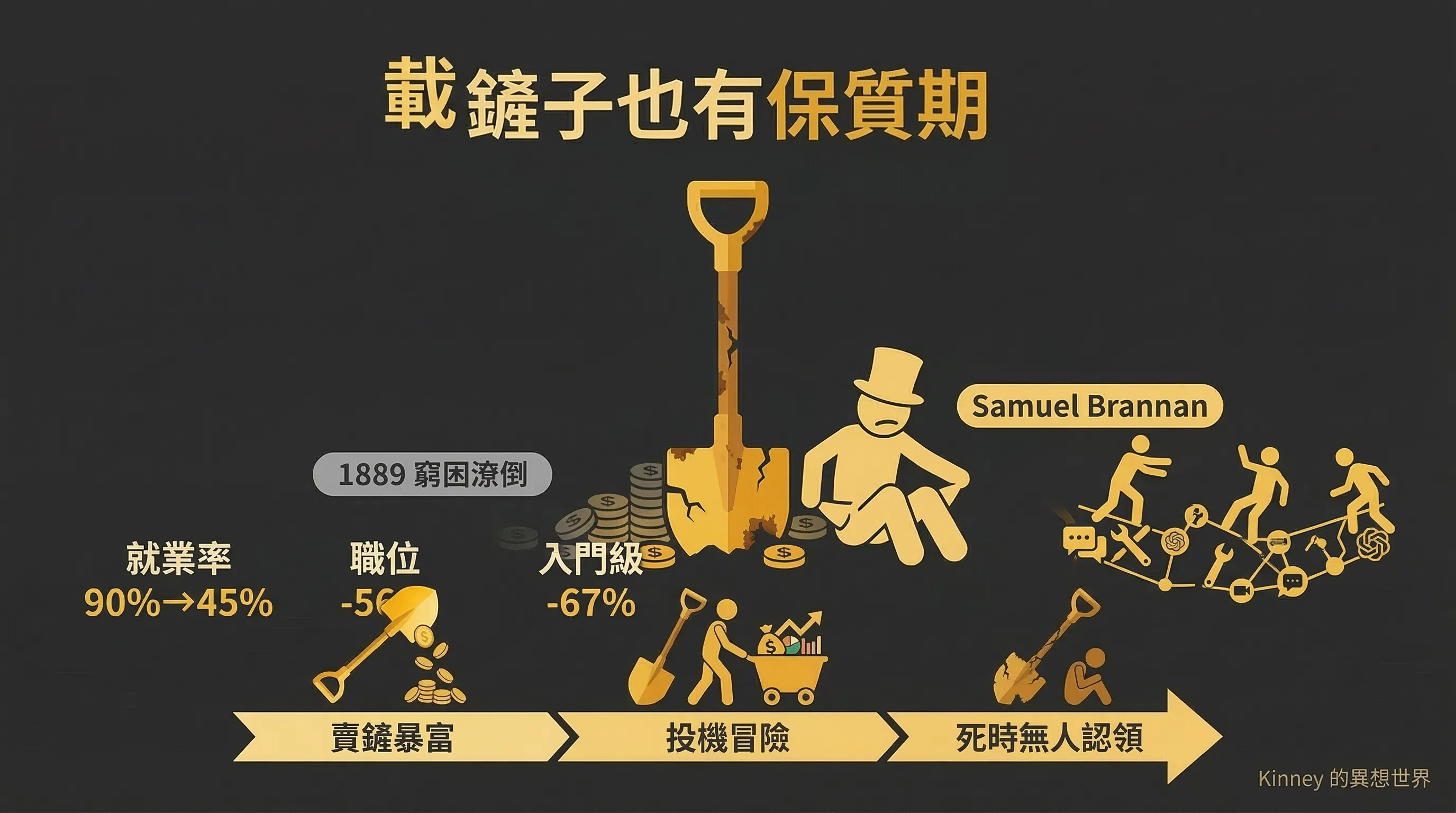
His name was Samuel Brannan, California's first millionaire. His method had nothing to do with gold. What he did was simple: he opened a general store near the mining camps, selling shovels, pans, and tents. He even ran stories in his own newspaper hyping the gold finds — not because he planned to mine, but because every new prospector meant one more customer.
One hundred and seventy-seven years later, open your X feed, and Brannan's descendants are everywhere.
A recent post that racked up nearly 200,000 views was titled "7 AI Skills That Will Make You Filthy Rich in 2026." The author is AI Edge (@aiedge_), an account run by Miles Deutscher, a well-known KOL in Australia's crypto scene, with over 530,000 followers on X. The post uses a gamified countdown structure, ranking skills from 7 to 1, from Tool Stacking all the way up to AI Consulting. Each skill comes with seemingly specific pricing: $1,500–$3,000 for building internal tools, $2,000–$6,000 for Agent system design, and $5,000 audit fees plus $10,000–$20,000 project fees for AI Consulting. After reading it, you feel like the roadmap to riches has been laid out before you — all you have to do is start.
But the most brilliant thing about this post isn't the seven skills it lists. It's a perfect demonstration of the eighth skill: how to package thin air as a tutorial and sell it to you.
A Sales Funnel Disguised as a Pyramid
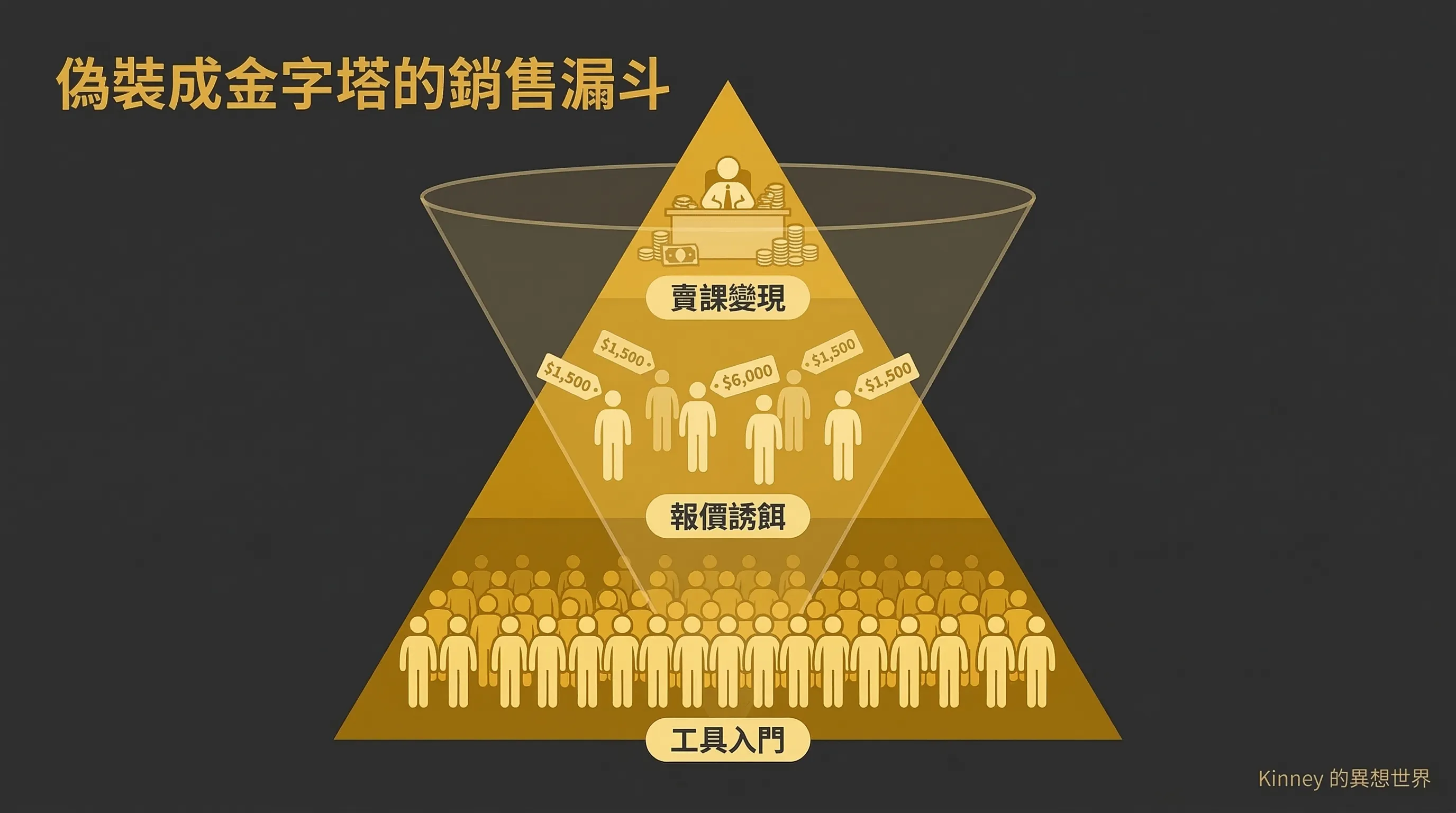
Lay out all seven skills and the structure becomes crystal clear.
The bottom three (Tool Stacking, AI Research Systems, AI Media Generation) have extremely low barriers to entry. Anyone who's downloaded ChatGPT thinks, "I could probably do that too." This is by design. Your psychological defenses get dismantled at this level. The middle two (Coding, Agentic Workflow Design) introduce concrete price tags — $1,500 to $6,000 anchored in your brain like pricing decoys. You start doing the math: one project a week, that's $6,000 to $24,000 a month. At the top, Prompt Engineering and AI Consulting are positioned at the summit, implying that if you just keep engaging with this account and keep learning, you'll eventually climb to the top of the pyramid.
This isn't an educational framework. It's the most classic Sales Funnel in the info-product industry: free long-form content for lead generation, paid courses or communities as the middle layer, high-ticket one-on-one consulting as the profit layer.
Where's the problem? "AI Consulting" isn't a skill — it's a business model. Putting a business model and operational skills on the same ranked list is like categorizing "opening a restaurant" and "chopping vegetables" as the same thing. And those seemingly specific price quotes? The $5,000 audit fee, the $20,000 project fee — not a single number comes with a source. No client names, no revenue screenshots, no third-party verification. Not even a blurry Stripe dashboard.
A software engineer on X named Baoyu once said: "Knowing how to type doesn't mean you can write; knowing how to write doesn't mean you understand publishing." Translated to the AI world: being able to chat with ChatGPT doesn't mean you can build workflows; being able to build workflows doesn't mean you can get a client to fork over $20,000. Between each layer isn't a quantitative accumulation — it's a qualitative leap. And this list smooths over every single leap, making you think the path from Tool Stacking to AI Consulting is one smooth upward curve.
The Same Promise Is Carved on Coding Bootcamp's Tombstone
If "learn AI skills and get rich" sounds perfectly reasonable to you, it's probably because you missed the last round.
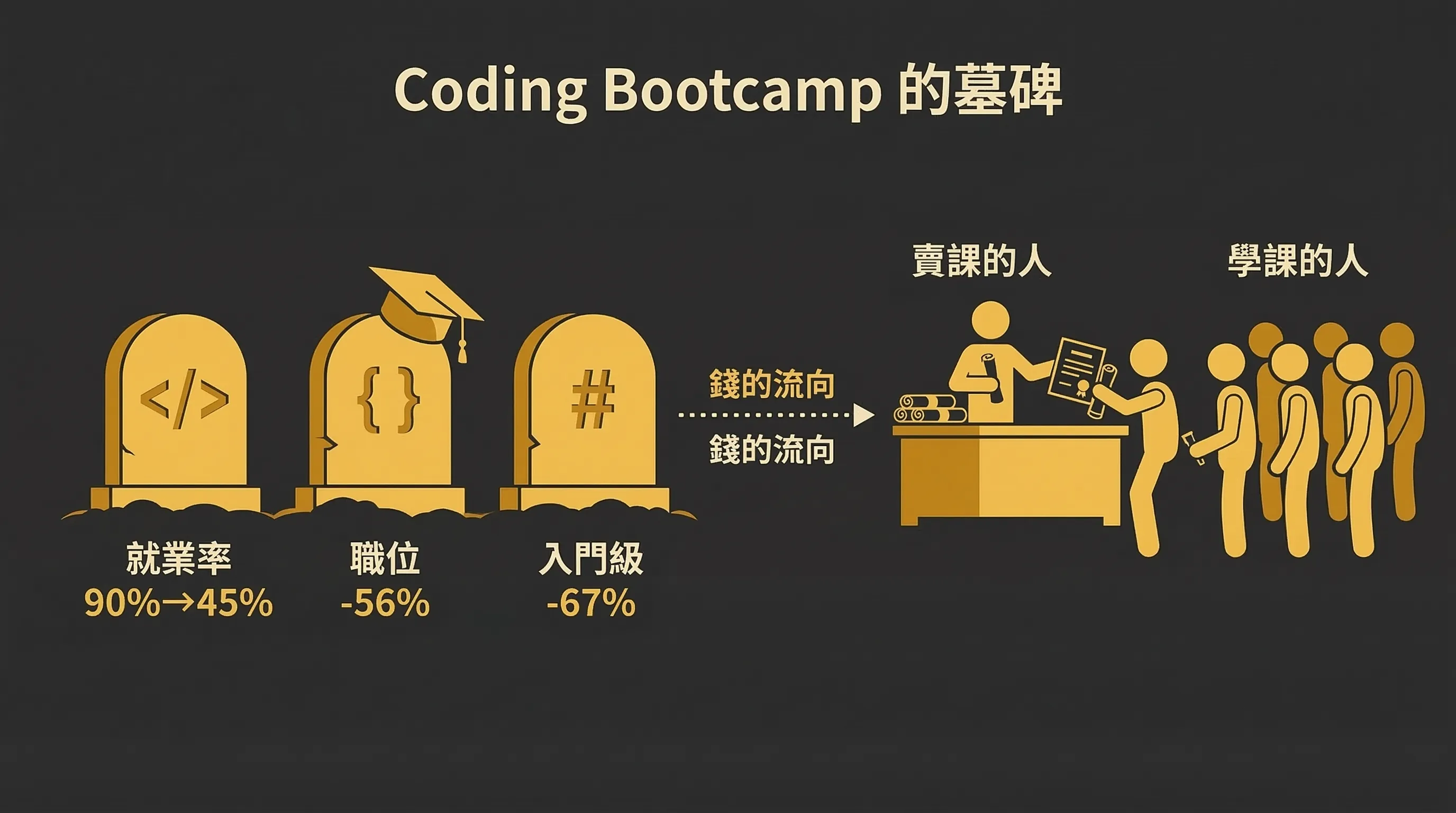
From 2015 to 2020, America's Coding Bootcamp industry went through an almost identical narrative cycle. The slogan was "Learn to code, six-figure salary in three months." Bootcamps claimed 90%+ employment rates, charged $10,000–$20,000 in tuition, and the ROI looked unbeatable.
Then the bubble burst.
Boston's Launch Academy saw employment rates plummet from 90% to below 60%, and suspended operations entirely. By 2023, according to unofficial statistics, top Bootcamp employment rates had been cut in half — from 80% to 45%. Data from CompTIA, the U.S. information technology industry association, showed software developer positions had declined 56% since 2019, with entry-level positions evaporating by 67%. Analysts described it as "the worst environment for entry-level tech jobs in decades."
The structural parallels are unsettling: inflated employment and income figures, vague "success stories," collective blindness to market saturation risk. And the most ironic thing they have in common: the people selling the courses always make more than the people taking them.
Baoyu also said: "Powerful tools amplify the capability gap between users." Most people intuitively assume that the more powerful the tool, the lower the barrier, and everyone becomes equal. Reality is the exact opposite. The more powerful the tool, the higher the top performers fly, while beginners merely go from "can't do it" to "can do a little but still have no competitive edge." It's like gym equipment being available to everyone — but the gap in physiques only gets wider, never smaller.
You might counter: but the compound annual growth rate for the Prompt Engineering market is 32%–35%, the outlook is bright! First check where the data comes from: platforms like Coursera and expertshub.ai make their money selling AI courses. Their market size estimates carry the same inherent conflict of interest as lung cancer research funded by tobacco companies.
More importantly, total market growth has never guaranteed that individuals sitting inside that market will get rich. From 2015 to 2020, the global mobile app market also had a CAGR above 30%, but the median income for independent app developers actually declined during the same period. The growth dividends were captured by Apple and Google, leaving individual developers in an increasingly crowded red ocean. The AI skills market growth numbers you see today are very likely walking the same path.
Attention Traders Always Chase the Next Wind

Miles Deutscher's career trajectory is itself the most compelling evidence. Not that what he teaches is useful. Quite the opposite.
In 2019, during Melbourne's COVID lockdown, he started investing in Bitcoin and Ethereum. When the 2020 DeFi wave arrived, he dove into research and analysis. In 2022, he joined crypto live-streaming platform Crypto Banter as a host, specializing in project deep-dives and investment strategies, amassing over 530,000 followers on X. His core identity was crystal clear: a cryptocurrency analyst and educational content creator.
Then crypto's attention dividend peaked. AI's attention dividend took off.
He founded AI Edge, calling it "the most profitable business I expect to build." Notice: AI Edge's target audience is "people who want to make money from AI." His crypto-era target audience was "people who want to make money from crypto." Both sides attract the exact same demographic — 25 to 40 years old, side-hustle anxiety, willing to pay for a "roadmap to riches." It's fundamentally the same business with a different skin.
This isn't an isolated case. A February 2026 survey by cryptocurrency exchange Phemex showed that large numbers of Korean crypto KOLs are shifting their attention from digital currencies to U.S. AI stocks. Blockchain media outlet The Block reported Bitcoin miners dumping BTC to invest in AI infrastructure. The phrase "crypto pivot to AI" had been circulating in the industry since mid-2023.
The pattern is razor-clear: 2017 ICO, 2021 NFT, 2024 Memecoin, 2026 AI. The vehicle changes; the playbook doesn't. Their operating system is "audience → content → monetize." Whether the raw material is blockchain or large language models is entirely irrelevant.
What they sell isn't knowledge — it's hope. And the most beautiful thing about hope as a product is this: the buyer can never return it.
So What's the Real Moat?
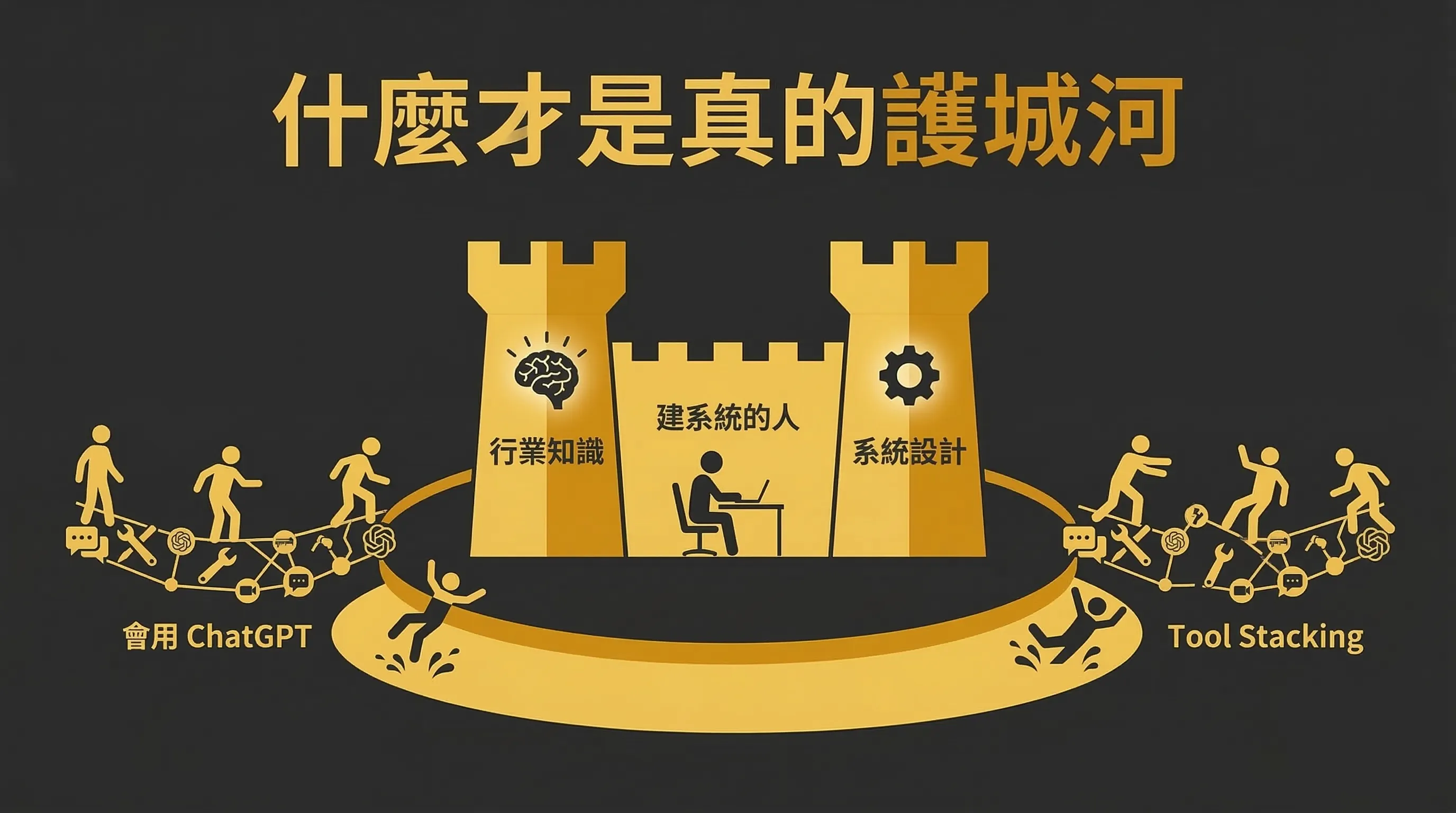
Two months ago, I wrote an article titled "Why Knowing How to Use AI Is No Longer Enough." The core thesis is simple: "knowing how to use AI" is tracking the same depreciation curve as "knowing how to use Excel." In 2024, being fluent with ChatGPT was still an advantage. By 2026, it's as redundant as asking someone "do you know how to use the internet?"
The real moat has never been at the operational level. It lies in two places: Domain Expertise and System Design.
AI Consulting as a business has a self-contradicting structure. It's quite fun to take apart.
If AI tools are really as easy to pick up as Miles claims — just stack them together and you're off to the races — then why would any company pay you $5,000 for an audit?
If AI can really make individuals effortlessly rich, why isn't Miles himself using AI to take on client projects instead of writing long-form posts on X selling courses?
The answer isn't complicated: he knows exactly which side of the fence the easier money is on. Selling shovels has always been more stable than digging for gold.
Reality is already squeezing the margins out of this business. On freelancing platform Fiverr, AI chatbot development services have been driven down to $100–$500 flat rate, with price wars compressing individual AI consultants' profit margins to almost nothing. On the other side, companies with budgets are building in-house AI teams, reducing dependence on external consultants. 2026 has been called "the year of AI reckoning" by many analysts — not because AI doesn't work, but because enterprises are starting to seriously ask one question: you say AI improves productivity — where are the numbers?
A lot of companies have combed through their reports and can't find a single number they'd put on a slide.
Even Shovels Have an Expiration Date
Miles Deutscher says in his post that the AI skill gap is "the biggest wealth opportunity in twenty years."
The biggest wealth opportunity twenty years ago was Web 2.0. The people who actually got filthy rich weren't those who learned to write HTML and CSS. It was Mark Zuckerberg, Larry Page, and Sergey Brin — the ones who built entire systems. Learning skills has never made anyone rich. Building systems does. And the people telling you "learn these seven skills and get rich"? The system they themselves are building has a name: information product sales funnel.
What happened to Samuel Brannan?
After the Gold Rush receded, he plowed his fortune into land speculation and political adventures, ultimately dying penniless in 1889. California's first millionaire couldn't even afford his own funeral — his body went unclaimed for over a year.
Even the shovel-selling business has an expiration date.
常見問題 FAQ
Can you really not make money learning AI skills?
You can, but not the "filthy rich" kind the post promises. According to freelancing platform Fiverr's market data, AI chatbot development services have been driven down to $100–$500, far below the $1,500–$6,000 claimed in the post. The people who can command premium pricing are those with Domain Expertise and System Design capabilities, not those who've merely mastered operational skills.
Why are Coding Bootcamps considered a cautionary tale for AI skills training?
The rise and fall of America's Coding Bootcamp industry from 2015–2020 mirrors today's AI skills training landscape with eerie precision. According to CompTIA data, software developer positions declined 56% since 2019, with entry-level positions evaporating by 67%. The 90% employment rates once claimed by Bootcamps had shrunk to 45% at top institutions by 2023. The structure is identical: inflated promises, vague success stories, and collective blindness to market saturation.
Who is Miles Deutscher? Is his AI Edge account credible?
Miles Deutscher is a well-known KOL in Australia's crypto scene. He started investing in Bitcoin in 2019, joined crypto livestreaming platform Crypto Banter as a host in 2022, and accumulated over 530,000 followers on X. When crypto traffic peaked, he founded AI Edge and pivoted to AI. His target audience has always been the same demographic: 25–40 year olds with side-hustle anxiety, willing to pay for a "roadmap to riches." This "attention trader" pattern has repeated from 2017's ICO wave through 2026's AI wave — the vehicle changes, the playbook doesn't.