Why People Inside a Bubble Always Believe 'This Time Is Different'
A bubble is not everyone believing the same lie. It is people with different motives being pushed into the same buy order. From the railway boom of 1873 to subprime ratings, this essay examines how profits, career pressure, financing, and identity turn 'this time is different' into apparent consensus.
By July 2007, the cracks in the subprime market were visible to anyone willing to look. Two highly leveraged Bear Stearns funds were collapsing, and investors had begun to question whether neatly packaged mortgage securities were really as safe as their ratings claimed. Yet Citigroup, then one of the world's largest banks, was still financing one major acquisition after another. When the Financial Times asked chief executive Chuck Prince when Citi would finally pull back, he replied: "As long as the music is playing, you've got to get up and dance. We're still dancing."
Within months, the music stopped. Prince resigned, Citi recorded enormous write-downs and later needed government support. A party that had seemed impossible to end became the worst global financial crisis since the Second World War.
Years later, Prince's line became an epitaph for Wall Street arrogance: they were greedy; we would have known better. But his words actually acknowledged that liquidity would eventually disappear. His problem was not an inability to see danger. It was that staying on the dance floor brought bonuses, market share, and quarterly earnings, while leaving first imposed an immediate cost.
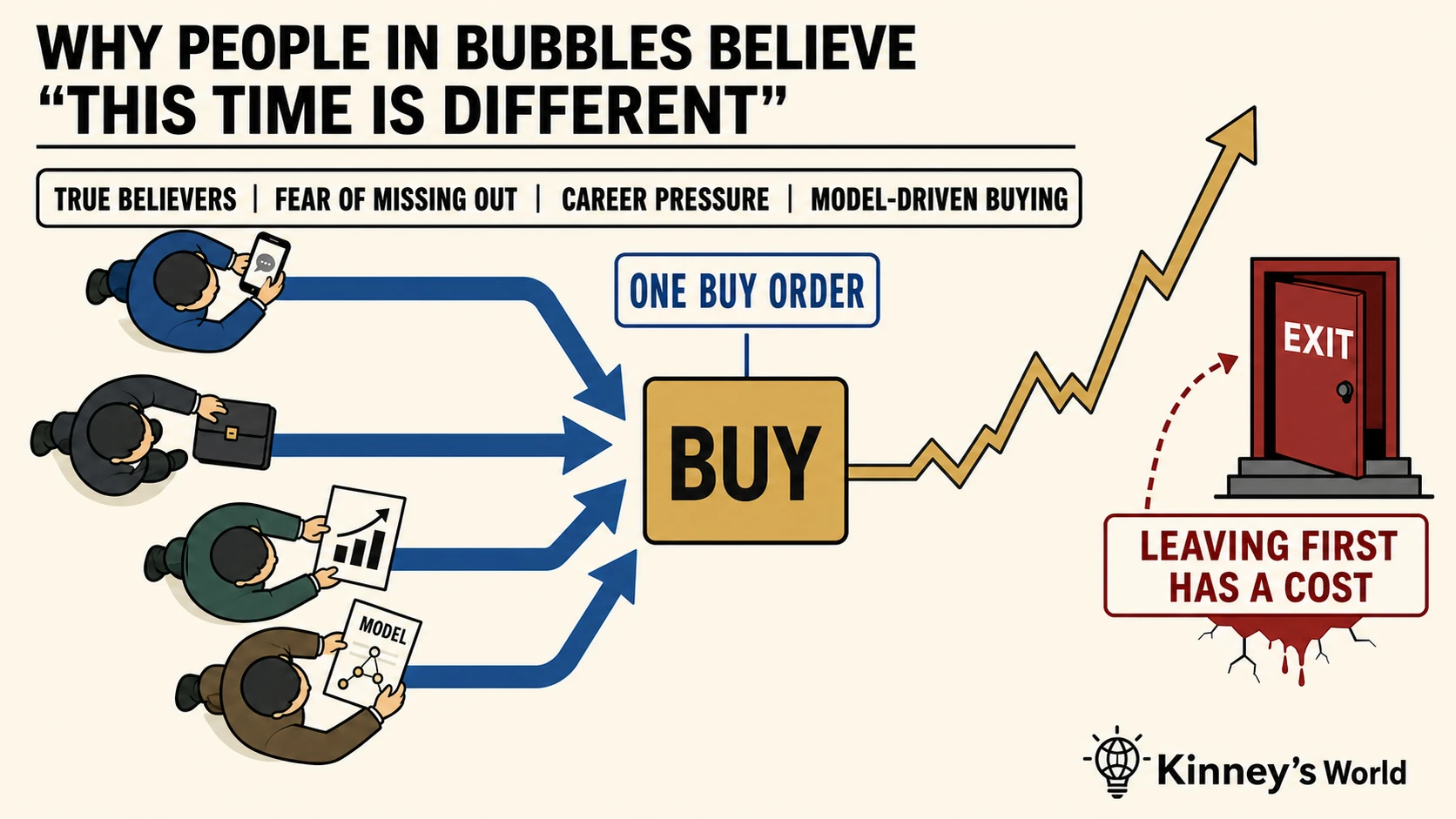
A bubble is not a crowd suddenly believing the same lie. It is more like a group of people who do not trust one another, yet take the same action for entirely different reasons. Price adds those actions together and announces to the world that consensus has formed.
Bubbles Usually Begin With Something True
A story with no truth behind it may become a scam, but it rarely grows into a bubble large enough to reshape society. The biggest bubbles usually attach themselves to a genuinely important change. In the nineteenth century it was railways. At the end of the twentieth century it was the internet. Today it may be artificial intelligence. Railways really did cut a journey across the American continent from months to days. The internet rewrote the cost of moving information. AI may transform the production of a great deal of knowledge work. These are not lies. They are facts powerful enough to excite a generation.
Real value is precisely what makes the story so difficult to challenge. When someone questions the valuation, supporters can point to real technical progress. When someone warns about excess capacity, they can cite long-term demand growth. When someone asks about cash flow, they can say that old measures cannot capture a new era. Every answer has a point. The problem is that none of them answers the question of price.
Railway investors in the 1870s were not wrong about the transport revolution. Railways later transformed the geography of American cities, agriculture, and industry. What they misjudged was the demand for each route, construction costs, the debt burden, and how long capital markets were willing to wait. The long-term social return could be enormous while the early return to investors was low enough to bankrupt them.
The distinction is simple, but it disappears easily in a bull market. "The technology is useful" quietly becomes "the company will make money." Then "the company will make money" becomes "the shares are worth buying at any price." In a bull market, people rarely stop to separate those three steps. They slide directly from useful technology to unlimited valuation, while optimism fills the logical gaps.
When Profits Begin to Rewrite a Person
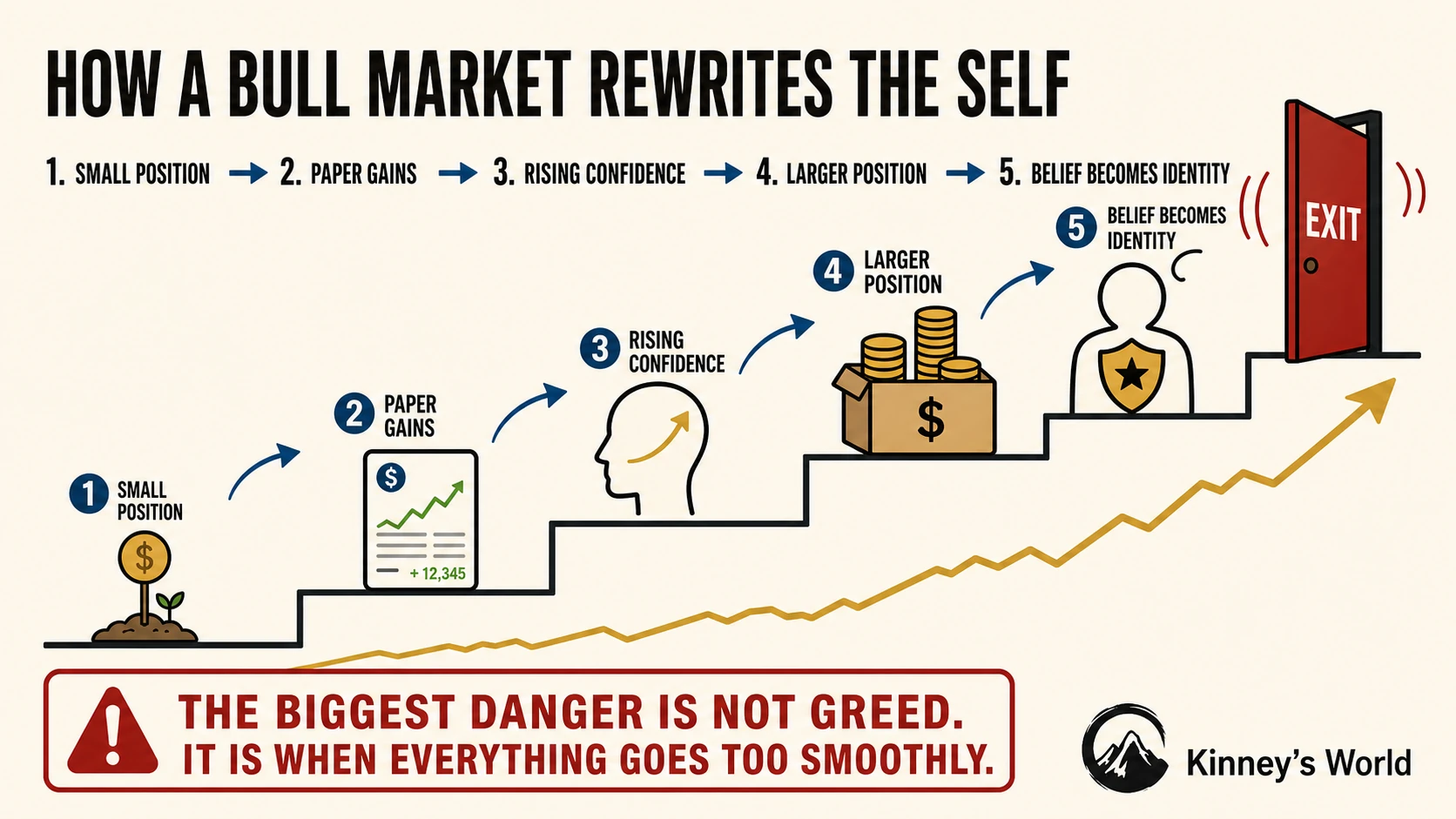
Few people enter a bubble as true believers, and fewer still commit everything on the first day. It often begins with a small position. The thought is not "a new era is certain" but "even if I am wrong, I cannot afford to miss it completely." The money is an admission ticket, ensuring that the investor will not be the only person left behind.
Then the price rises and the small position makes money. The profit brings more than wealth. It feels like recognition from the market. What began as an experiment slowly becomes proof that "my judgment was right." The investor increases the position. Every rise makes the story more credible and the original doubts less necessary.
There are always warnings, but the market does not collapse immediately. People pay attention when the first warning fails. After the fifth or tenth failure, the critics begin to look like permanent pessimists who are always too early. What hurts most is not merely watching one's own profit, but seeing people who appear to understand less earn far more. Caution stops looking like skill and starts looking like incompetence. Refusing to participate no longer feels like risk control; it feels like failure.
Once the position grows, the investment becomes part of personal identity. Admitting error no longer means accepting a financial loss. It means admitting that one's research, judgment, and sense of superiority were all weaker than imagined. Bad news becomes "short-term noise." A falling price becomes an opportunity to buy more. Evidence that was supposed to test the belief is repurposed to protect it.
Belief inside a bubble rarely forms overnight. It is trained by a succession of small gains, failed warnings, and comparisons with other people. The most dangerous psychological state may not be greed, but the feeling that everything is going too smoothly. A bull market does not merely teach investors that prices will keep rising. It teaches them that their way of seeing the world has always been right.
A Bubble Does Not Need Everyone to Believe
True believers are only one part of a bubble. Another group already thinks valuations are expensive but expects the uptrend to continue. They do not need to believe in the final destination. They need only believe that the next buyer has not disappeared. Walter Bagehot warned in the nineteenth century that speculators who think they can escape before the crash may be more dangerous than the ignorant, because they mistake awareness for immunity.
Another group has barely considered whether it can escape in time because professional position already constrains its choices. Fund managers have to keep pace with an index. Banks must protect market share. Analysts must preserve client relationships. Corporate managers must deliver quarterly growth. For them, risk is not only the possibility that the asset will fall. It is also the cost of refusing to participate while it keeps rising.
Then comes a less visible force: large pools of capital that never make a complete judgment about the story. They move according to index weights, credit ratings, volatility models, or asset-allocation rules. They do not need to believe that this time is different. They need only follow the instruction to keep buying.
Four groups can hold completely different views while the market environment pushes them through the same door. Price cannot distinguish motive. Genuine belief, tactical participation, professional pressure, and mechanical buying all appear as another transaction. People do not see the difference. They see higher turnover, higher prices, and a chart becoming steeper by the day.
When Price Begins to Prove the Story
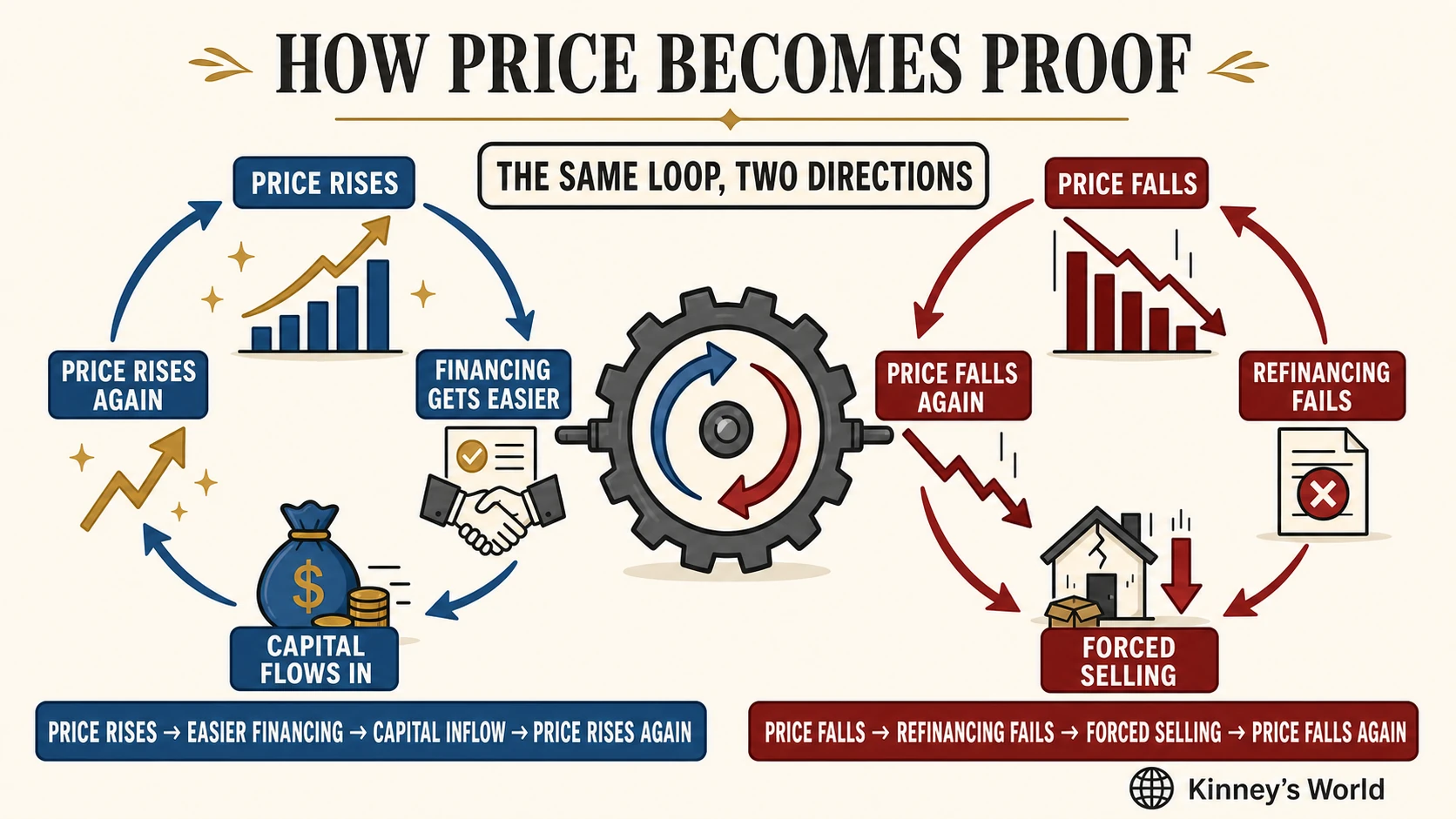
A bubble becomes dangerous not when the claims at the party grow more extravagant, but when price itself starts supplying evidence for the story. A rising share price makes it easier for a company to issue equity. Rising bond prices lower financing costs. Higher property values let borrowers obtain larger loans against more valuable collateral. The rise is no longer merely the result of optimism; it becomes a new reason for optimism.
Railway finance before 1873 produced exactly this loop. Bonds funded construction. Construction progress supported land and security prices. Higher prices encouraged banks to keep lending. The easier credit became, the more railway companies could build, and that visible progress was treated as evidence of demand and success. The cycle could last long enough for participants to confuse "we can still refinance" with "the project is already generating an adequate return."
Jay Cooke's bank used short-term funds to support the Northern Pacific Railway. The problem was not that the railway would never have value. It was that creditors could not wait for that value to arrive. A railway took years to build, and revenue depended on population and freight developing over time, while interest payments arrived on schedule. Many American railways then carried roughly three dollars of debt for every dollar of equity, and long-term construction depended on selling new bonds. As long as another investor was willing to buy, the timing mismatch seemed not to exist. Once the bonds stopped selling, "building the future" immediately became "where will today's cash come from?"
The housing market before 2008 used different instruments, but the loop survived. Rising home prices made default losses appear manageable. Borrowers in difficulty could refinance or sell appreciated property. Historical defaults looked low, so models declared the securities safe. High ratings attracted more capital, and more capital expanded mortgage lending further. When home prices turned, the supporting links reversed together: collateral shrank, refinancing failed, ratings were cut, and funding fled. Each step accelerated the next.
Financing structure determines what remains after a bubble bursts. If an investment is funded by common equity and a company's own cash, shareholders bear most of the failure. If it depends on short-term debt, margin finance, and repeated use of the same collateral, falling prices enter the banking and credit system. A project may still have long-term value but no cash today. Once lenders refuse to roll the debt, collateral falls and forced sales push prices lower, a temporary shortage of money can destroy assets that could otherwise have waited. Investors think they are judging the value of an asset. In reality, they are also betting that the entire refinancing chain will remain intact.
When Scores Begin to Replace Judgment
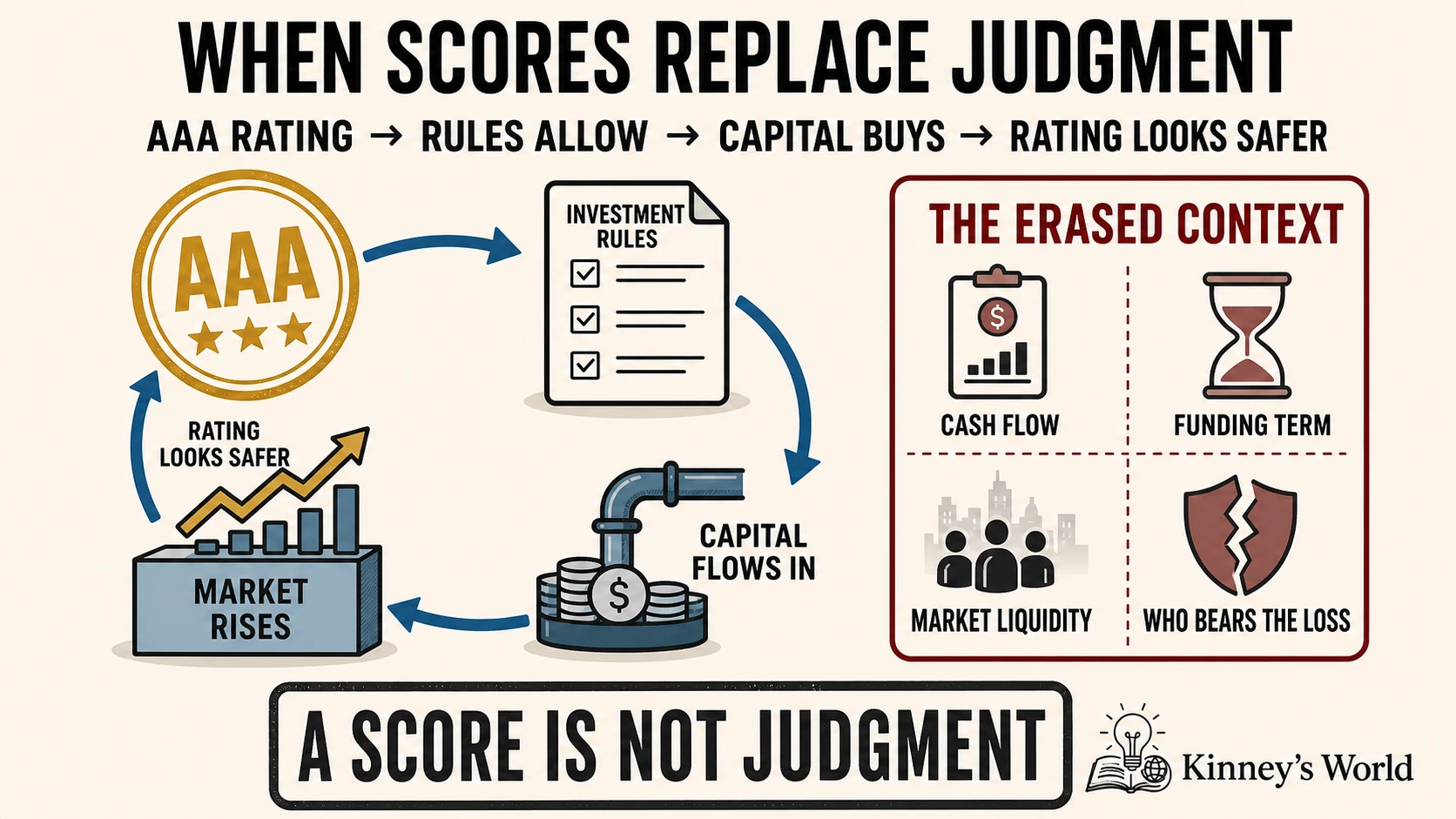
If stories and prices still leave room for anxiety, modern finance offers another source of comfort: a score. AAA is not a conditional argument. It is a symbol everyone understands. It can be written into investment mandates, regulatory rules, and capital models. It also lets decision-makers say after a disaster that they simply followed the accepted standard.
The US Financial Crisis Inquiry Commission concluded that rating agencies were not observers standing outside the market. Their ratings made huge volumes of mortgage-related securities sellable, and some investors were constrained by regulation to rely on them. Between 2000 and 2007, Moody's assigned AAA ratings to nearly 45,000 mortgage-related securities. A large majority of the securities rated AAA in 2006 were later downgraded. A rating was not merely an opinion. It was an entry pass to balance sheets around the world.
Once complex judgment is compressed into a score, the missing context becomes harder to see. When that score controls funding and rewards, people start optimizing for the score itself. Rating agencies need to protect market share. Issuers need higher ratings to reduce financing costs. Investors need to comply with internal rules. A manager no longer has to explain the quality of every mortgage pool to the board; it is enough to say that the securities are AAA. Regulators do not need to understand every structure anew; they insert the rating into a capital formula. Investors do not need to admit that they are betting on home prices, default correlations, and market liquidity; they say the model has already calculated the risk. Everyone acts on the score. The score therefore appears more reliable, and begins changing the world it claims merely to measure.
Which score is making the decision for me? Ratings, rankings, backtests, composite model scores, and market share can provide information. They cannot replace cash flow, financing structure, management incentives, or the question of who ultimately pays when the judgment is wrong. A number can be accurate without being sufficient to support an entire investment decision.Who Has the Power to Bet, and Who Bears the Loss?
Chuck Prince was operating inside precisely this environment. As long as clients demanded acquisition financing, Citi's withdrawal would hand revenue and relationships to competing banks. As long as the market did not collapse immediately, an early pullback would make the bank look timid and incompetent in its quarterly results. Before the crisis arrived, the cost of caution was concrete while the cost of risk remained abstract. You could worry, but not meaningfully reduce exposure. You could raise concerns, but not abandon the revenue. A bubble does not have to eliminate doubt. It only has to strip doubt of the power to exit.
This is why power and responsibility belong inside investment analysis. Do the people who can increase leverage, weaken standards, or continue investing capture most of the reward when things go well? When they are wrong, do managers bear the loss themselves, or pass it to shareholders, creditors, employees, customers, and eventually the government? When decision-making power and loss responsibility separate, managers keep the gains while others carry the downside. Continuing to take risk becomes the natural choice. A balance sheet alone may not reveal this form of exposure.
This Time Can Be Different, and the Price Can Still Be Wrong
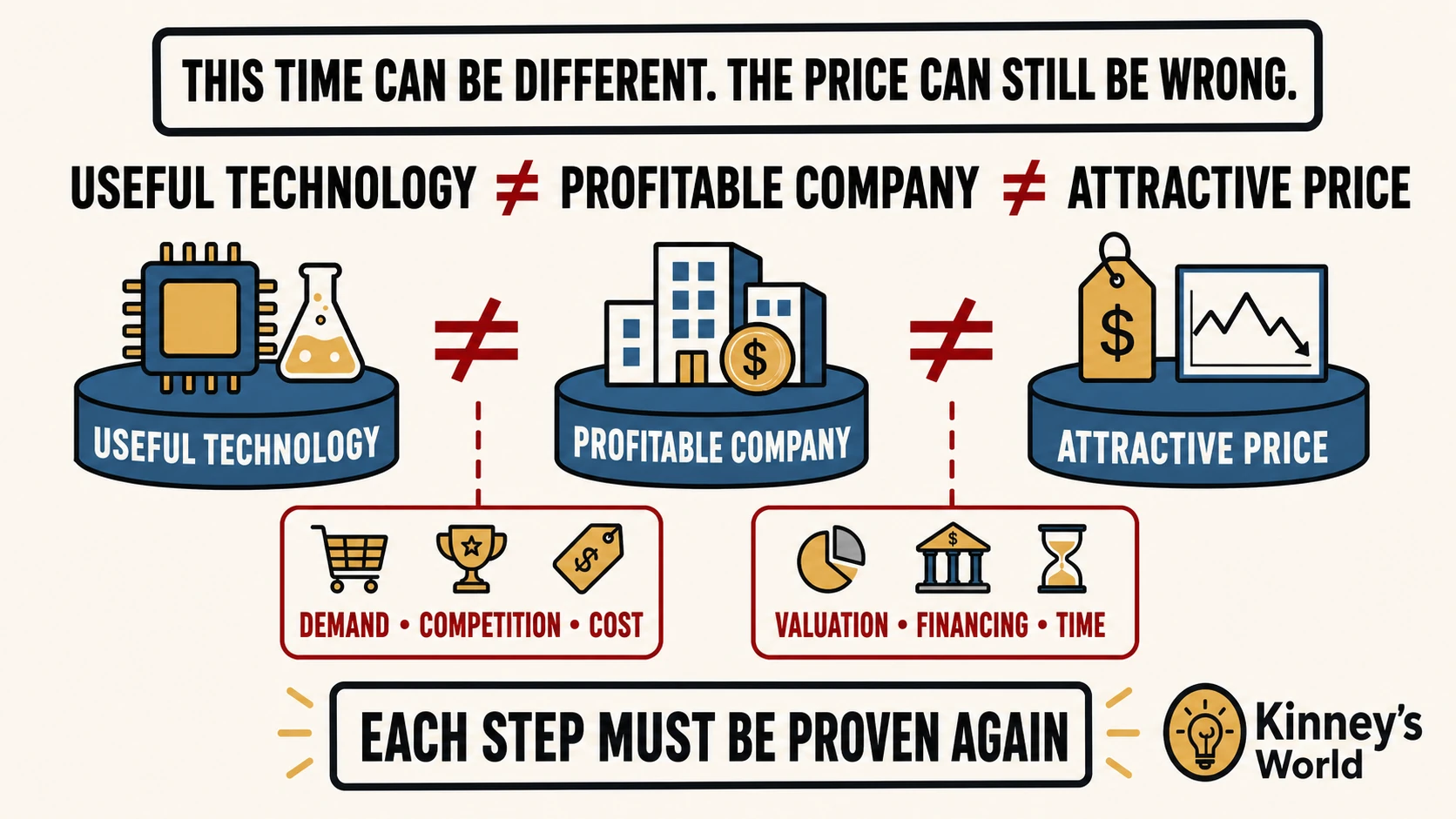
Railways changed America. The internet changed the world. Artificial intelligence may genuinely rewrite the cost structure of many industries. There is no contradiction between accepting that a new technology has real value and accepting that it can be mispriced.
The cheapest use of historical analogy is to find an old bubble whenever a new technology appears and declare the ending in advance. Railways, the internet, and AI differ materially in technology, business models, funding sources, and policy environments. Treating AI as a replay of the railway crisis of 1873 is no more analytical than declaring that every new technology will produce endless prosperity.
Today's largest technology companies have mature revenue and cash flow, and much of their AI investment does not depend on continually rolling high-interest debt. That changes the transmission mechanism. Weak returns may first damage profits and valuations rather than trigger an immediate run on banks. But the risk has not disappeared. Part of it has moved from "can the debt be repaid?" to "can this investment generate enough revenue, will the capacity be used, and can supply-chain margins survive?"
Sometimes "this time is different" is a correct observation. The error begins when investors take one genuine difference and extend it into the disappearance of every constraint. Different technology does not abolish the cost of capital. A different business model does not abolish competition. More stable financing does not make price irrelevant. History should not hand down a verdict. It should force us to state our assumptions clearly.
Write Down the Exit Conditions Before Entering
It is difficult to stay completely clear-headed inside a bubble. Prices, revenue, and the success of people around us all seem to prove, every day, that our caution came too early. Instead of demanding perfect immunity, write down in advance a few questions that cannot be rewritten at will.
Is price supporting the financing and the story? When a rise itself enables more borrowing, better ratings, larger positions, and more optimistic forecasts, the market has entered a self-validating loop. The crucial question is not whether the share price can rise again tomorrow, but which condition supporting the rise is most likely to disappear first. If the answer still depends on the next pool of money entering, the investor is not judging only asset value. The bet is also on the market's ability to keep believing in itself. Who has decision-making power, who receives the reward, and who bears the loss? Do management incentives encourage risk-taking? Who receives the gains when that risk succeeds? Who pays when the judgment fails? The further decision-making power is separated from responsibility for losses, the stronger the incentive for managers to take greater risks, because someone else pays for the mistake. What new evidence would make me change my decision? This is the most important question and the one most often avoided. If every new fact can be dismissed as short-term noise, the process is no longer investment judgment; it is identity defence. Disconfirming evidence must be written down before the position is opened, together with a deadline, a threshold, and the action that follows. Otherwise, people can always rewrite the story after a loss.One more question is necessary: even if my long-term judgment is correct, can I survive until the market proves it? Leverage, margin calls, fund redemptions, and short-term debt do not pause because history will eventually vindicate you. Investors can be right about the destination and still die before reaching it.
When the Music Becomes Truly Dangerous
Bear markets frighten people. Bull markets educate them to trust themselves. After prices rise for long enough, caution looks like incompetence, leverage looks like efficiency, and luck looks like skill. The largest loss of an investor's life often does not arrive suddenly when everyone is panicking. It is built gradually during the pleasant, rational, easy days when adding to the position feels most natural.
Chuck Prince's line endured not only because he later left Citi in disgrace, but because it captured the most dangerous moment in a bubble. People on the floor do not have to believe the party will last forever. They simply do not want to be the first to leave. The music is still playing and the floor is still crowded. The exit is in plain sight, but the person who walks toward it first must pay immediately.
The real danger is not believing that the world has changed. The world does change. The danger is deleting one piece of evidence that could change your mind every time the price rises, until the dance floor has no exit left and only the music remains.
常見問題 FAQ
Why do the largest bubbles often grow around genuinely useful technology?
Because real value protects the story. Nineteenth-century railways really did cut travel across the United States from months to days, while the internet and AI changed the cost structure of information and knowledge work. The relevant questions are whether the company can earn a return, whether financing can last, and whether the purchase price is reasonable. *1873* shows how a technological revolution and the bankruptcy of early investors can occur at the same time.
Why do investors stay even when they know valuations are expensive?
Because the cost of leaving first is immediate while the cost of a crash remains abstract. When Citigroup chief executive Chuck Prince said in 2007 that the music was still playing, he already acknowledged that liquidity would eventually disappear. But a bank that withdrew first would immediately lose revenue, clients, and market share. Fund managers, analysts, and corporate executives face similar professional pressure.
How can investors tell whether a bursting bubble will become a financial crisis?
The key is not valuation alone, but financing structure. Failures funded by common equity and corporate cash are borne mainly by shareholders. Short-term debt, margin finance, and repeated collateral transmit falling prices into banks and credit markets. The US Financial Crisis Inquiry Commission reported that Moody's assigned AAA ratings to nearly 45,000 mortgage-related securities between 2000 and 2007, helping regulation and investment rules direct enormous pools of capital into the same assets.