The Only Madman to Win a Nobel Prize — He Won Twice
John Nash rewrote economics at 22 with a 26-page thesis, then spent 30 years in schizophrenia, and went 45 years without medication — pulling himself back through sheer willpower, like dieting. Nobel Prize, Abel Prize. The world acknowledged twice that he was right.
🎬 Video version: YouTube
The Phantom of Fine Hall

Fine Hall, Princeton University's math department, has a long corridor with blackboards stretching from floor to ceiling on both sides. During the 1970s and 80s, late at night, a man with no faculty position, no office, and no official status of any kind would walk in alone and fill the blackboards. Not mathematical proofs. Not lecture notes. Enormous numbers raised to enormous exponents, interspersed with commentary on world leaders and cryptic political declarations. The formatting was obsessively neat, the handwriting unmistakable. If a curious graduate student sneaked an eraser across a word or two, the next day those words would reappear in exactly the same spot.
In May 1979, two graduate students, Mark Schneider and Steven Bottone, decided to do something nobody had done. Bottone later recalled: Mark sat in a wheeled office chair with a steno pad, and I pushed him from one blackboard to the next, copying everything down. As for how other students reacted to the writing, Bottone said the surface response looked like mockery, but underneath there was always a layer of awe.
The students called him the Phantom of Fine Hall. He wore a knit cap and circled campus on a slow bicycle. At the Dinky train station, at Small World Coffee, at the far end of the math department corridor, students tracked his movements like field biologists observing wildlife. Princeton's math department never expelled him, allowing him to use the facilities. Nobody gave him trouble. It was the best gift a university could give a shattered genius.
Nobody knew that thirty years earlier, this phantom had written a 26-page thesis that rewrote the fundamental logic of economics, military strategy, and biology. His name was John Nash.
One Sentence and 26 Pages
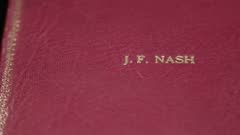
Nash got into Princeton on what may be the shortest recommendation letter in academic history. On February 11, 1948, his advisor at Carnegie Institute of Technology, Richard Duffin, wrote to Princeton's Solomon Lefschetz. The full text:
"Dear Professor Lefschetz: I am recommending John F. Nash, Jr., who has applied to enter Princeton as a graduate student. Mr. Nash is nineteen years old and will graduate from the Carnegie Institute of Technology in June. He is a mathematical genius. Sincerely, Richard Duffin."
Zero attachments. Zero supplementary remarks. He didn't even bother writing "the student has good character and grades." Just one sentence: "He is a mathematical genius." Done. It worked.
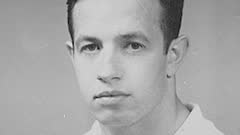
After arriving at Princeton, the 22-year-old Nash did something everyone thought impossible. At the time, game theory was entirely John von Neumann's territory. Von Neumann's framework could only handle two-player zero-sum games, or cooperative games where players could form alliances and sign contracts. He assumed people would naturally form coalitions, then analyzed the strategies between them. This framework dominated the entire field.
Nash asked a completely different question: what if nobody cooperates? No alliances, no contracts, not even communication — everyone fights independently. What happens? His answer: in any such game, regardless of how many players or strategies, at least one stable equilibrium point exists — a point where nobody can improve their position by unilaterally changing strategy. This is the Nash Equilibrium.
An example. During the Cold War, the U.S. and Soviet Union each possessed enough nuclear weapons to destroy the other. Both knew that if one launched first, the other would retaliate — mutual annihilation. So nobody pressed the button. Not because either side loved peace, but because in this game, "don't move" is the Nash Equilibrium — any unilateral change in strategy makes your position worse. Nash proved this equilibrium exists in every game. Pricing wars, arms races, which route you take to work every morning — all the same mathematical structure.
Twenty-six-page thesis, two citations. One was von Neumann and Morgenstern's _Theory of Games and Economic Behavior_. The other was Nash's own previous one-page paper. Someone later said: the reward for inventing a new field is that your references can be short enough to look like a joke.
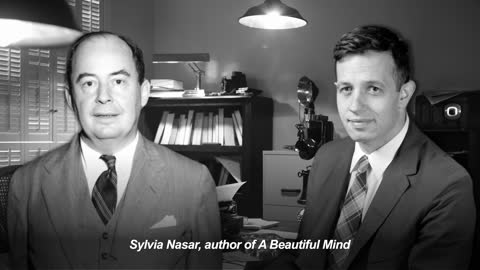
Then he took the idea to von Neumann himself. In 1949, von Neumann was the most influential mathematician on the planet — even the atomic bomb calculations went through him. Nash walked in and began explaining his concept. Von Neumann cut him off: "That's trivial, you know. That's just a fixed point theorem."
Nash never went back to von Neumann. Years later, he attributed the reaction to "the natural defensive posture of a mature thinker toward a young rival." Biographer Sylvia Nasar wrote that this interpretation "perhaps reveals more about what was going on in Nash's own mind when he walked into von Neumann's office than about von Neumann's mindset."
The irony: von Neumann's own minimax theorem also used a fixed point theorem. The mathematical tool was indeed simple. Von Neumann didn't miss the math — he missed the concept. He failed to see that those 26 pages had redefined how large a world game theory could describe. Someone later summarized it neatly: sometimes, very important theorems can have very simple proofs. The point was never the tool — it's what you cut open with it.
Nash also visited Einstein. He went to the Institute for Advanced Study and spent nearly an hour explaining his ideas about gravity and radiation. Einstein listened, smiled kindly, and said: "You had better study some more physics, young man."
Twenty-two years old. Shot down in succession by the two greatest minds of the twentieth century. But that 26-page thesis later won a Nobel Prize. Von Neumann died in 1957, never living to see the thing he called "trivial" become a cornerstone of economics.
The Same Neural Pathway
Then his brain betrayed him.
December 31, 1958. A New Year's Eve party. Nash appeared wearing a diaper, a sash reading "1959" around his waist, a pacifier in his mouth, spending most of the time curled in his pregnant wife Alicia's lap, alternating between the pacifier and a baby bottle of bourbon and milk. Colleagues called it "odder than usual." But what followed made everyone realize "odd" didn't begin to cover it.
At MIT, he walked into the common room with the _New York Times_, pointed at the front page, and told everyone that extraterrestrial forces were communicating with him through the newspaper. The messages were encrypted; only he could decode them. He asked everyone he met: "Do you know the secret number?" — trying to identify fellow members of a hidden organization. He spent hours analyzing the Köchel numbers of Mozart symphonies, searching those digits for codes corresponding to his own life trajectory. He believed he was simultaneously the Prince of Peace and the Emperor of Antarctica — and this wasn't metaphor. He actually wrote letters to embassies in Washington, signed "John Nash, Emperor of Antarctica," announcing he was forming a world government.

In early 1959, the American Mathematical Society invited him to speak at Columbia University. The scheduled topic: a proof of the Riemann Hypothesis, one of the most significant unsolved problems in mathematics. 250 people showed up, expectations sky-high. The lecture was complete gibberish. Colleagues present immediately understood — this wasn't "something seems off." Something had fundamentally broken. This was John Nash's public breakdown.
In the film _A Beautiful Mind_, Nash is shown seeing three vivid hallucinatory figures: a fictional Princeton roommate, a government agent, and a little girl. The audience discovers alongside Nash that these people don't exist. That's Hollywood, not reality. The real John Nash never saw people who weren't there. His hallucinations were auditory — voices in his head. He described them himself: "Like a telephone in my brain, from people who opposed my ideas." The film's three hallucinatory characters were entirely fabricated to help audiences understand what schizophrenia feels like. Real schizophrenia isn't that easy to understand.
Years later, someone asked him how a mathematician of his caliber could possibly believe he was Emperor of Antarctica. Nash's answer may be the most chilling sentence in the history of psychiatry:
"The ideas about supernatural beings came to me the same way that my mathematical ideas did. So I took them seriously."
This sentence explains everything. The neural circuit that produced the Nash Equilibrium and the neural circuit that produced the Emperor of Antarctica delusion were the same one. He couldn't distinguish between them because both felt exactly the same. When inspiration arrives, you don't receive a label telling you whether it's genius or madness. They aren't two sides of a coin. They're the same side.
Dieting

Nash was hospitalized repeatedly throughout the 1960s, undergoing insulin shock therapy and early antipsychotic medication. In 1970, he made a decision every psychiatrist opposed: permanently stopping medication. For the next 45 years, until his death in 2015, he never took another psychiatric drug.
The film lied about this too, at a crucial point. In a scene set around 1994, Russell Crowe's Nash says: "I take the newer medications." This line was deliberately fabricated. Nash himself was furious when he learned about it. The _Guardian_ reported it bluntly: "This line was fabricated, and it was consciously fabricated." The film needed a recovery story audiences could accept — medication, recovery, award. Reality wasn't like that.
The real Nash used a metaphor to describe his method, one so precise it's painful. He said managing delusions was like dieting. A continuous, conscious, willpower-driven practice. Every day, monitoring his own thoughts, identifying paranoid ideas, then vetoing them. Just as someone wanting to lose weight must consciously refuse fats and sweets, he had to consciously refuse his brain's most natural impulses. He deliberately forbade himself from thinking about religion and politics, because those were the two areas where his delusions raged most violently. He called these times "enforced rationality." Every time the voices came, he didn't flee or fear. He asked himself one question: Does this follow logic?
No. Then it isn't real.
Sounds simple. But imagine: the voice in your head telling you something is the same voice that tells you 1+1=2. What you have to do is use reason to override signals sent by reason itself. The brain is simultaneously judge and defendant.
He won. But clarity had a cost. In his Nobel Prize autobiographical essay, Nash wrote a passage more important than any of his mathematical papers:
"Gradually I began to intellectually reject some of the delusionally influenced lines of thinking. But this is not entirely a matter of joy, as if someone was recovering from a physical disability to good health. One aspect of this is that rationality of thought imposes a limit on a person's concept of his relation to the cosmos."
The last sentence carries the most weight. When he was mad, he was Emperor of Antarctica, the sole decoder of cosmic secrets, the most important person in the world. After clarity returned, the universe shrank — back to the size an ordinary person can contain. In another context he said: "In a certain sense, sanity is a form of conformity. People always assume mental patients are suffering. But I think madness is also an escape. When reality isn't good enough, you may imagine something better."
He chose the smaller universe. Every day. Like dieting. For 45 consecutive years without interruption.
The Boarder
Alicia Lardé met Nash in an advanced calculus class at MIT. She came from El Salvador; he came from a small town in West Virginia. Both were outsiders in their respective environments. They married in February 1957.
Happiness didn't last long. In early 1959, Alicia, pregnant, was forced to make a decision she knew her husband would never forgive: committing him involuntarily to McLean Hospital outside Boston. A friend recalled Alicia's thinking: she wanted to preserve his career, his intellect. She cared about keeping Nash intact as a person. Nash didn't see it that way. He hated her.
On December 26, 1962 — the day after Christmas — Alicia filed for divorce. The divorce papers stated that Nash had turned against her for committing him twice, moved to a separate room, and hadn't shared a bed with her for over two years. Alicia later briefly hoped to marry another math professor, John Coleman Moore. The film deleted the entire divorce, portraying a saintly woman who never left.
About those years, Alicia said only one thing: "I tried my best to stay positive. I really tried not to feel sorry for myself."
In 1970, Nash emerged from a psychiatric hospital yet again — empty-handed, nowhere to go. Alicia took him back, not as a husband, but as — in her own word — a boarder. She explained her decision without a hint of romantic embellishment: "They said a lot of people get left in the back wards of mental hospitals. The few chances they have to get out just slip by, and then they stay in there forever. So that was one of the reasons I said, 'Well, I can take you in.'"
Sylvia Nasar's assessment left no room for debate: "Had she not taken him in, he would have been a street person. He had no income, no home. I think Alicia saved his life." Nasar called Alicia "the real hero of this story. During those lost years, she still loved him."
Alicia raised their son John Charles alone, with help from her mother. John Charles was later diagnosed with schizophrenia. Same family, two generations, same illness. And Alicia was one of the very few female students in MIT's physics department in the 1950s — attaining that level in that era was itself a gift. She put that gift down and spent decades suspended between poverty and two schizophrenic men.
In 2001, 38 years after their divorce, Alicia and Nash remarried. Her explanation was one sentence: "We thought it was a good idea. After all, we'd been together most of our lives."
The film portrays Alicia as a romantic martyr. The real Alicia divorced, despaired, considered marrying someone else. The real woman was far stronger than her screen counterpart, because her perseverance didn't come from not knowing what giving up felt like — it came from tasting every bitterness and still choosing to stay. Not a romance. One person betting an entire life that another person might still come back. She won the bet.
The Nobel That Almost Wasn't
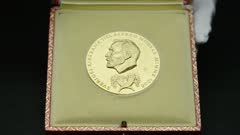
The 1994 Nobel Prize in Economics nearly didn't go to Nash.
Assar Lindbeck, Sweden's most influential economist, was the core figure on the selection committee and championed Nash. But another committee member, Ingemar Stahl, fought tooth and nail against it. Stahl's objections stacked high: Nash was a mathematician not an economist, his research was done too early, he stopped academic work very young, and most critically, he had a mental illness and might cause a scene at the ceremony, embarrassing the Nobel Prize.
On the eve of the vote, Swedish economist Jörgen Weibull made a special trip to Princeton to covertly visit Nash and assess his mental state on the committee's behalf. He found Nash extremely nervous, unable to maintain eye contact, with speech that occasionally "drifted." Weibull felt that in terms of eccentricity, Nash wasn't much different from many Princeton professors. But what truly shifted Weibull's position wasn't these observations — it was one brief moment. They walked together into Princeton's faculty club, and Nash suddenly stopped, anxiously asking: "Can I go in? I'm not faculty." A man who had rewritten an entire discipline, at the university where he'd spent decades, wasn't sure he had the right to walk through a door. From that moment, Weibull became Nash's staunchest supporter, arguing that "Nash's continued obscurity was itself an injustice that needed correcting."
Armed with Weibull's report, the committee went to a final vote. Stahl lost the internal debate but did something unprecedented in Nobel history: he took his objection to the full assembly of the Royal Swedish Academy of Sciences, triggering an open floor debate. The final vote gave Nash and co-winners John Harsanyi and Reinhard Selten a pass by just a few votes — the closest an economics prize had ever come to being blocked. The uproar was severe enough to trigger institutional reform: committee terms were changed from unlimited to three years.
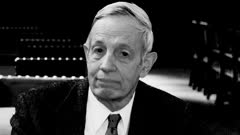
On December 10, 1994, Nash received the medal from King Carl XVI Gustaf of Sweden. But the committee did not invite him to deliver the customary one-hour Nobel lecture, because they weren't sure he could make it through. The film's moving speech where he thanks Alicia and speaks of "the equation of love" never happened. The reality: Nash accepted the award, bowed to the audience, and sat down. The film's scene where Princeton professors line up to present pens in tribute was also entirely fictional — Princeton has no such tradition.
Lindbeck later reflected on the experience: "Nash was different. He had received no recognition at all, lived in genuine misery. We brought him back into the sunshine. In a sense, we resurrected him."
Won It All
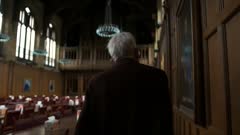
In 2015, Nash received the Abel Prize in Norway — mathematics' highest honor — shared with Louis Nirenberg.
Nobel Prize in Economics. Abel Prize in Mathematics. The world acknowledged twice that he was right. The first time was for the 26-page thesis he wrote at 22. The second was for even earlier mathematical work. His brain was both his greatest weapon and his most dangerous enemy, and he used the same brain to win twice.
On May 23, Nash and Alicia flew back to New York from Norway. He was eighty-six; she was eighty-two. The plan was mundane: land at Newark, their pre-arranged car would be waiting, drive home. But they caught a flight five hours early. At the airport, the car wasn't there. Louis Nirenberg's daughter Lisa Macbride happened to be picking up her father and lent Nash a phone to call the car service. The dispatcher said: "We thought you weren't arriving for five more hours." No solution offered. Macbride said to them: "You can take a taxi." That sentence would pain her for a long time.

The taxi driver's name was Tarek Girgis. He'd been driving a cab for only two weeks. Before that, he drove an ice cream truck. On the southbound New Jersey Turnpike, Girgis tried to pass a Chrysler, lost control, and hit the guardrail. Nash and Alicia were thrown from the car. Neither was wearing a seatbelt.
A 911 call: "There are two people trapped under the car. We think they might be dead."
Both died at the scene. Girgis sustained minor injuries and was not charged. Nirenberg recalled their week in Norway: "They were in great spirits. It was a wonderful week."
His brain used the same pathway to produce a theorem that rewrote the world and a delusion of being Emperor of Antarctica. He spent 30 years using the willpower of a dieter to pull himself back from madness, going 45 consecutive years without a single pill. His wife bet an entire life on him. The world acknowledged twice that he was right.
Then a former ice cream truck driver, two weeks into his taxi career, ended it all on the highway.
_Sources: Sylvia Nasar, A Beautiful Mind; Nash's Nobel autobiography; Guardian reporting; NSA declassified files. Corrections welcome if any factual errors are found._
_—Kinney's Wonderland_