The Hong Kong Government Just Wrote a Defense Brief for the 47
Same government, same weekend. 'Legitimate rights' can protect a company's cranes in Panama, but cannot protect a citizen's right to cast a vote in their own city.
February 23, 2026 was a good day to study Chinese.
That day, the Hong Kong SAR Government issued a statement using the following phrases: "improper seizure," "lack of transparency," "without coordination," "strong protest," "resolutely safeguard the legitimate overseas rights of Hong Kong enterprises." These words described the Panamanian government's forced takeover of ports operated by CK Hutchison. Beijing responded faster than Hong Kong — China's Ministry of Foreign Affairs added: "resolutely safeguard the legitimate rights of Chinese enterprises."
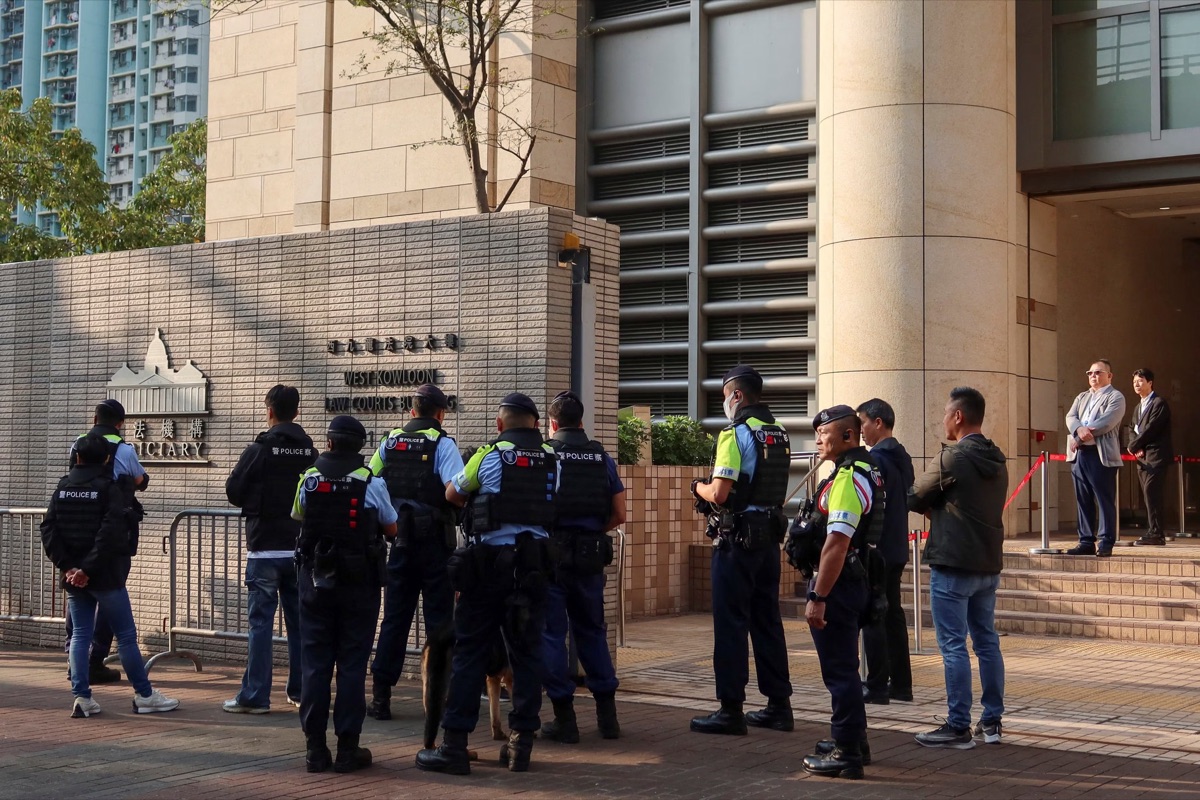
The same day, the Hong Kong Court of Appeal dismissed appeals from 12 defendants. These 12 were among the "47 defendants" who organized an unofficial primary election in 2020, allowing citizens to vote for their preferred candidates. The legal name for this act: "conspiracy to subvert state power."
The two events landing on the same weekend was pure coincidence. But language never lies.
What Happened to a Hong Kong Company in Panama
CK Hutchison began operating ports at both ends of the Panama Canal in 1997, investing over $1.8 billion, with contracts extending to 2047. For nearly thirty years, these ports ranked among Central America's most efficient shipping facilities, with zero contract violations. The contract was even renewed in 2021.
Then Trump arrived. He publicly pressured Panama to "reclaim" canal sovereignty, even though the canal had been transferred to Panama since 1999. Trump's logic was typical: I want it, therefore I should have it. Panama's Supreme Court conveniently ruled in January 2026 that CK Hutchison's concession contract was "unconstitutional," on the grounds that the original signing procedures were flawed. A contract that operated for nearly thirty years and was renewed once suddenly had procedural problems — right after pressure from the White House.
On February 23, the Panamanian government sent people in under the banner of "urgent social interest." CK Hutchison personnel were expelled. Cranes, computers, equipment — all seized. CK Hutchison's statement used two English words: unlawful, no prior notification or coordination.
The Hong Kong government was furious. "Improper seizure," "lack of transparency," "without coordination" — precise, powerful language, like it was written by someone who'd attended law school. Every word said the same thing: you cannot deprive a legal entity of its legitimate rights without due process. These words are worth remembering. We'll need them in a moment.
What Happened to 47 People in Hong Kong
In July 2020, a group of pro-democracy figures organized an unofficial primary election in Hong Kong. Over 610,000 voters participated. The primary's purpose was simple: before the official election, let supporters vote on who the pro-democracy camp should field, to avoid splitting their own vote. In mature democracies, this is called a "party primary." Both American parties do it every four years. Nobody considers it a crime.
On January 6, 2021, before dawn, approximately one thousand police officers knocked on doors before sunrise and arrested 55 people. Ultimately, 47 were charged with "conspiracy to subvert state power." Forty-five received sentences ranging from 4 to 10 years. Benny Tai, as the alleged "mastermind," received 10 years. Eighteen have now served their sentences and been released, but their lives have been pried open once and can't be put back together.
On February 23, 2026, appeals from 12 of them were dismissed. The court's conclusion: the purpose of organizing the primary was to win a majority in the Legislative Council, then veto the budget, forcing the Chief Executive to resign. This strategy conforms to the explicit provisions of the Basic Law, but the court ruled that using legal means to achieve political ends itself constitutes "subversion."
In other words, the crime wasn't the act — it was the intent. Everything you did was legal, but what you were thinking was criminal.
If this logic holds, any opposition party in any election that tries to win a majority can be charged with "conspiracy to subvert." Because the purpose of winning a majority is always to push your own policies and block the other side's — which is synonymous with "paralyzing government operations." The daily functioning of democracy has become a national security threat in Hong Kong.
How did the National Security Law come about? On the night of June 30, 2020, Beijing bypassed Hong Kong's Legislative Council and inserted the law directly into Annex III of the Basic Law. Throughout the entire process, the Hong Kong public didn't know the law's content beforehand, couldn't amend it afterward, had no consultation period, no debate, and no vote. Hours before the law took effect, even the then-Secretary for Security admitted he hadn't seen the full text.
In the Hong Kong government's own vocabulary: is this not "lack of transparency"? Is this not "without coordination"?
As for "improper seizure," the 47 didn't lose ports, cranes, or computers. They lost the right to participate in politics, their personal freedom, ten years of their lives. A company's $1.8 billion investment warrants a "strong protest." The freedom of 47 people warrants a court judgment. If seizing a company's equipment is called "improper seizure," what do you call seizing a citizen's freedom?
The Selective Blindness of "Legitimate Rights"
Put the two events together, and the picture is complete. Same government, same weekend. The phrase "legitimate rights" can protect a company's cranes in Central America but cannot protect a citizen's right to cast a ballot in their own city. "Due process" can condemn a foreign government's hasty actions but cannot question a law that dropped from the sky at midnight. "Improper seizure" can describe the transfer of port equipment, but when 47 people were taken away at dawn, the same vocabulary suddenly vanished from the dictionary. A company's cranes have rights; a citizen's vote does not.
This isn't a double standard. This isn't accidental irony. A double standard at least acknowledges that two standards exist. This is something more fundamental — it's structural: language itself has been conscripted. A government's linguistic system is like its legal system — not designed for consistent application, but for selective application.
Hayek wrote in _The Road to Serfdom_: when the law ceases to protect individual freedom and becomes a tool for government to achieve specific objectives, the rule of law is dead. Every rule-of-law principle the Hong Kong government invoked on the Panama issue, held up as a mirror against the 47 defendants' case, looks like a shattered mirror. The mirror isn't broken — the person looking in it is selectively showing only half their face.
The problem isn't that some official is a hypocrite. Officials turn over generation after generation, but the statements' wording remains precisely the same, because the function of this linguistic system was never to describe reality but to serve needs. When condemning foreign countries is needed, "rule of law," "procedural justice," and "legitimate rights" clock in on time. When domestic dissidents need to be dealt with, the same vocabulary automatically clocks out. Language has no personality, but the institution that uses it does.
The Boomerang
CK Hutchison's statement said the Panamanian government acted "unlawfully" with "no prior notification or coordination." On January 6, 2021, when Hong Kong police knocked on every door before dawn, was there "prior notification"? When the National Security Law parachuted from Beijing into Hong Kong, was there "coordination"? Does the legal basis for sentencing the 47 to a combined total of over 200 years meet everyone's understanding of "lawful"?
Of course, there is one crucial difference between the two events. CK Hutchison can initiate international arbitration, file lawsuits, and call for justice before the whole world. Those 12 among the 47 — after their appeals were dismissed — can no longer do any of those things.
_(Sources: HKSAR Government statement, MFA PRC spokesperson, Panama Supreme Court ruling, CK Hutchison announcement, Basic Law provisions, Hayek's The Road to Serfdom. Corrections welcome if any factual errors are found.)_
_—Kinney's Wonderland_