IBM's Miss Reveals the Real Priority Order in Enterprise Tech Spending
IBM clients shifted quarterly capital spending toward servers, storage and memory, yet ServiceNow, Microsoft and Datadog kept growing. The real dividing line is not hardware versus software, but the cost of delaying a purchase.
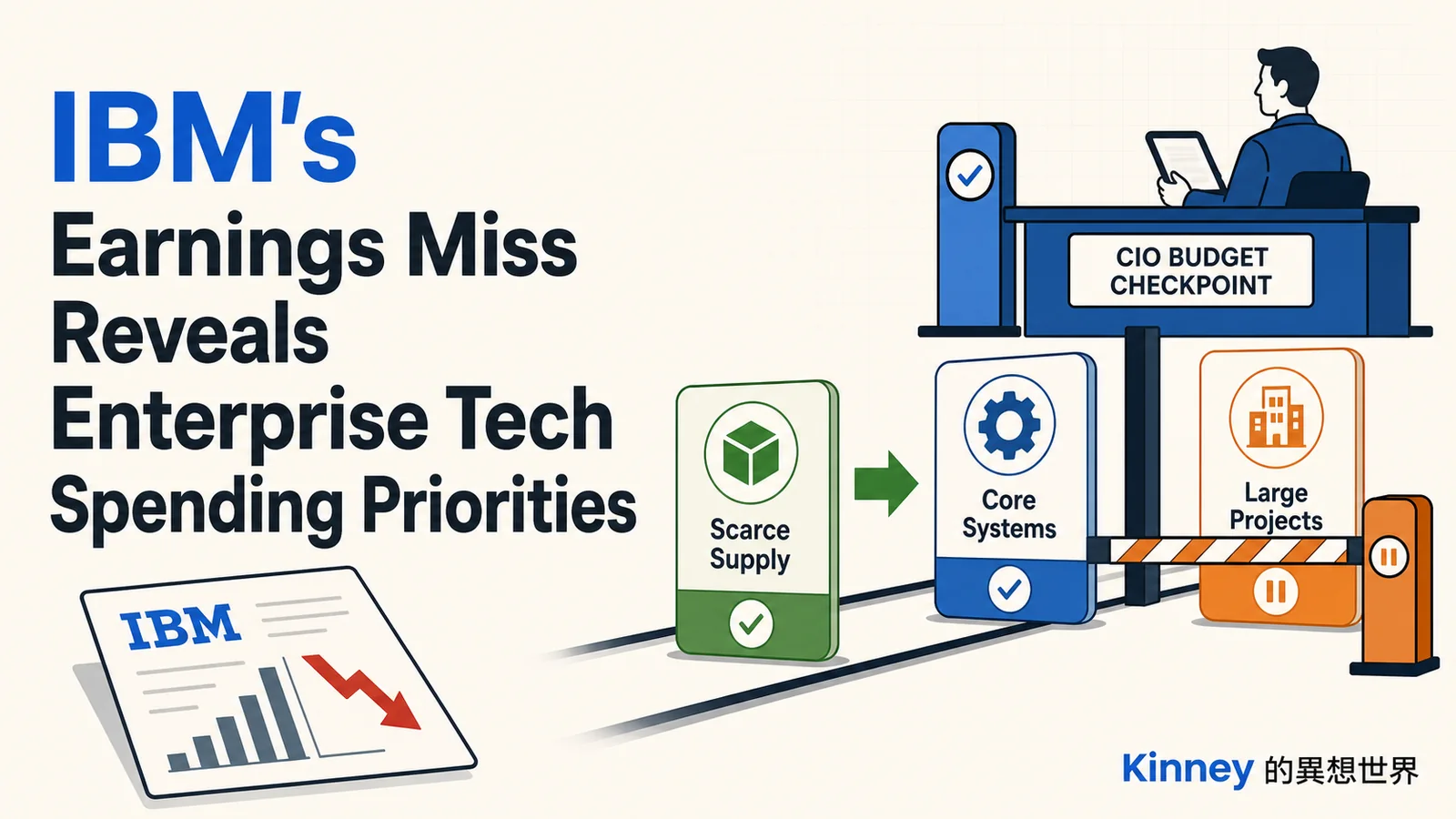
By the end of June, IBM's clients were still willing to spend. Several large deals simply failed to close on schedule. Clients used their quarterly capital budgets first on servers, storage and memory, hoping to secure the equipment they needed before supply tightened further and prices rose.
IBM's preliminary second-quarter revenue came in at $17.2 billion, up just 1%. Several large deals missed their expected closing dates, while Distributed Infrastructure revenue jumped 37%. Enterprises have not stopped investing in technology. They are deciding what must be bought first.
The Hardware-Software Divide Explains Too Little
The easiest explanation is that AI hardware is absorbing software budgets. Yet IBM's own software revenue still grew 5%, while Red Hat grew 11%. ServiceNow subscription revenue rose 22%, and current remaining performance obligations increased 22.5%. Microsoft Azure grew 40%, while commercial remaining performance obligations excluding OpenAI still increased 26%.
Datadog provides an even sharper contrast. First-quarter revenue grew 32%, while the number of customers generating at least $100,000 in annual recurring revenue increased 21%. On the day IBM disclosed its miss, DDOG shares rose about 4%. They were still up roughly 93% for 2026 through July 16. Both companies are labelled software stocks, but the market treated them very differently.
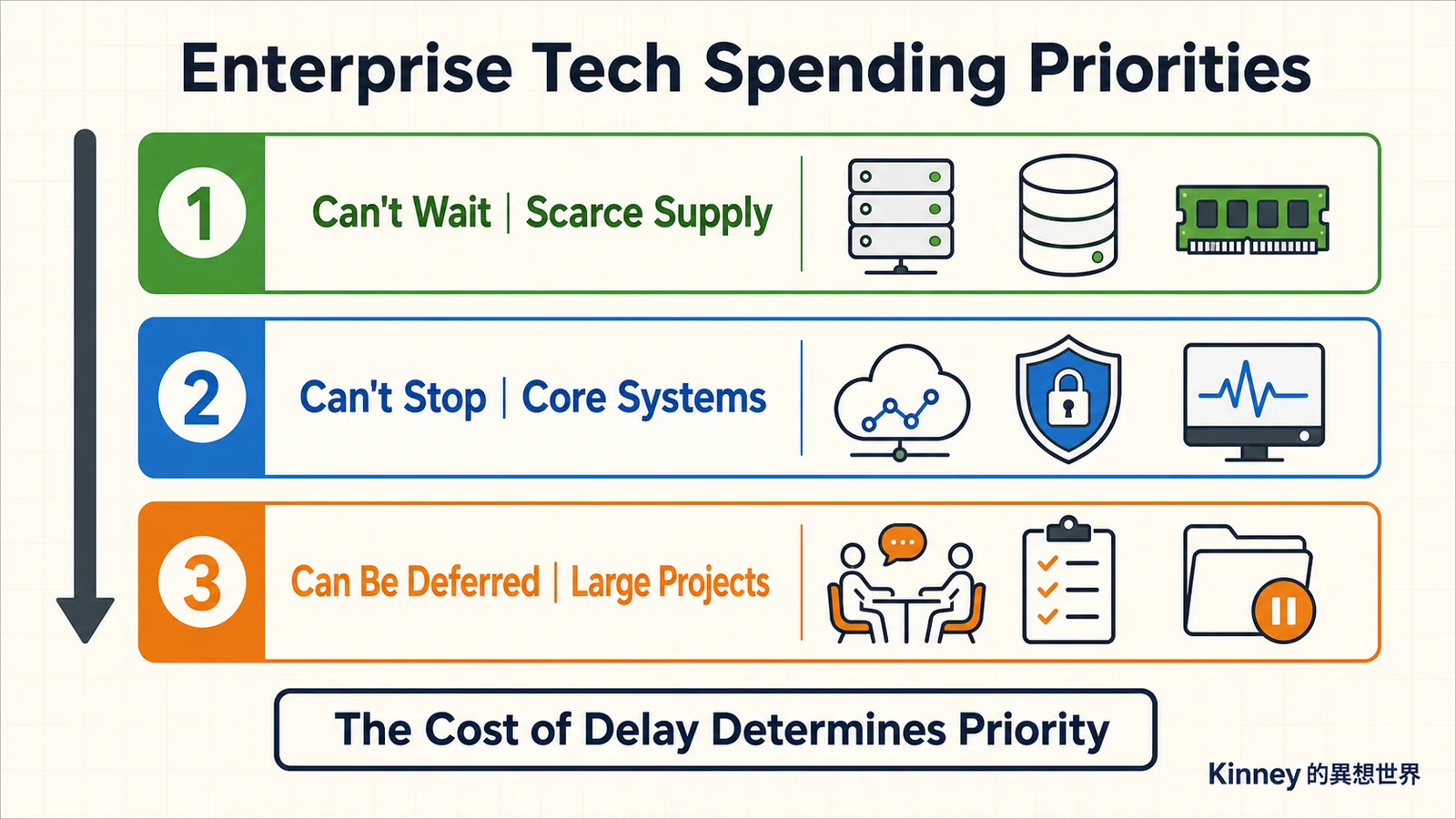
If hardware versus software were the decisive line, this divergence would be hard to explain. A better answer is that enterprises are ranking purchases by the cost of delay, not cutting spending by product category.
Some Orders Cannot Wait
Enterprise SSD contract prices rose by about 80% in the first quarter of 2026, and TrendForce expects server DRAM shortages to persist into 2027. Micron has signed supply agreements with 16 strategic customers extending through 2030. Some of Oracle's largest AI customers have even prepaid for GPUs or supplied their own.
The logic is straightforward. Wait one quarter and prices may be higher, delivery times longer, and AI deployments delayed by a lack of computing capacity. Scarcity gives immediate purchasing its own value.
Software can also sit near the front of the queue when delaying renewal is equally costly. Once a product handles identity management, workflows, cloud observability, security or data operations, an enterprise cannot switch it off casually to meet a quarterly budget target. The savings may create a much larger operational risk.
Datadog benefits from this logic. As companies add cloud and AI workloads, their systems become more complex. They can postpone a new implementation or consulting project, but they cannot stop monitoring cloud and AI systems that are already running. Even under budget pressure, clients remain reluctant to delay renewal. That behaviour says more about Datadog's position inside the enterprise than a feature list does.
What Gets Deferred Is the Change Itself
IBM also admitted that execution fell short and that the company did not adapt quickly enough to changing client behaviour. That matters, but it does not conflict with a shift in spending priorities. When clients have less time and management attention, vendors that cannot move approvals quickly feel the pressure first.
The difficulty with large new software and consulting projects often lies in what follows the purchase. Clients must migrate data, redesign processes, coordinate departments, train staff and assign someone to carry the risk if the project fails.
Accenture's latest quarterly bookings fell 2%. Consulting revenue grew 4%, while managed services grew 8%. Services that keep existing operations running still attracted demand. New projects that consume substantial management attention took longer to approve.
Enterprises tend to defer products that can wait without causing an immediate problem. Servers can be ordered now. A core system must keep running. A cross-department transformation project can spend another three months in discussion.
Customer Priority Reveals a Company's Real Strength
When budgets are abundant, every technology company can claim to sit at the centre of digitisation, cloud computing and AI. Once clients begin cutting, delaying and reapproving spending, the differences between products become clear.
If waiting means shortages or higher prices, a product has supply-driven pricing power. If failing to renew threatens current operations, software has operational pricing power. A deal that demands extensive new implementation and cross-department coordination, without affecting today's operations, is easier to delay.
DDOG is a line worth following. Last quarter's 32% revenue growth and 21% increase in large customers already showed that Datadog remained inside clients' priority budgets. Its shares still rose on the day of IBM's warning, reinforcing that view. The next earnings report is the test. If revenue, large-customer growth and full-year guidance remain solid, it will further confirm that enterprises still rank cloud, security and AI observability near the front of the queue.
IBM's miss exposed a reordering of enterprise technology spending. Hardware and software are only labels. The cost of delay determines priority, and the products clients are most afraid to postpone are the ones with real pricing power.
Further Questions
Does IBM's miss mean enterprises are cutting all software spending?
No. IBM's own software revenue still grew 5%, while Red Hat, ServiceNow, Microsoft and Datadog all showed that enterprises continue to pay for core software and cloud services. The miss points to a change in spending order, not the disappearance of software demand.
Why did companies prioritise servers, storage and memory?
Tight supply raises the cost of waiting. A delayed purchase can mean higher prices, longer delivery times or postponed AI deployments. When scarce hardware directly affects operating plans, securing supply moves ahead of projects that can wait.
How can investors tell whether a technology product has real pricing power?
Watch what clients postpone when budgets tighten. Stable renewals, remaining performance obligations, large-customer growth and full-year guidance show that a product remains a priority. The products clients are most reluctant to delay are the ones with genuine pricing power.
Sources
- IBM: Arvind Krishna's Letter to IBM Investors, July 14, 2026
- IBM: Form 8-K, July 14, 2026
- Datadog: First Quarter 2026 Results
- Datadog Historical Prices: WSJ
- Datadog Quote and Year-to-Date Performance: Yahoo Finance
- ServiceNow: First Quarter 2026 Results
- Microsoft: FY2026 Third Quarter Results
- Oracle: Fourth Quarter and Full-Year 2026 Results
- Accenture: Third Quarter FY2026 Results
- Micron: Third Quarter FY2026 Prepared Remarks
- TrendForce: First-Quarter 2026 Enterprise SSD Supply and Pricing
- TrendForce: Server DRAM Pricing and Long-Term Supply Agreements