America's One Country, Two Systems Economics
Wall Street is celebrating while employment collapses. Four datasets point in four directions — economists need a new letter: K. AI data centers account for 92% of GDP growth. Strip them out, and you're left with 0.1%. A 250-year forced marriage — AI is the divorce lawyer.
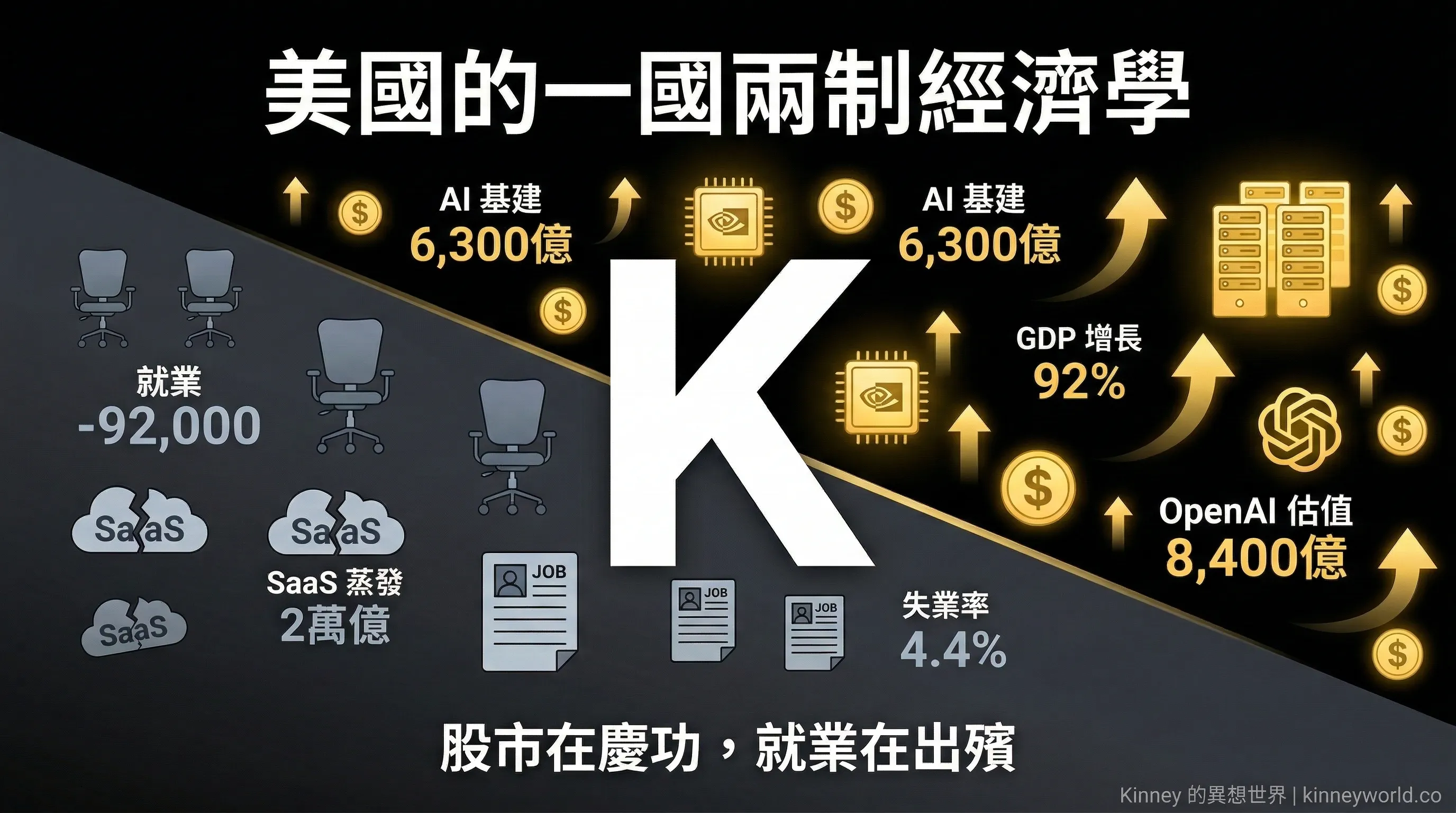
Wall Street celebrates. Employment collapses. | AI Risk Series | ~4,500 words
March 6th. The Bureau of Labor Statistics releases February's nonfarm payroll data. Negative 92,000. The three-month moving average drops to 6,000 per month, well below the population replacement rate. And December's numbers? Quietly revised from positive 48,000 to negative 17,000. A report that told you last month the economy was growing just came back and said: actually, it was shrinking.
Same week. J.P. Morgan's co-head of equity strategy Dubravko Lakos-Bujas publishes a report: the SaaS software sector collapsed 34% in twelve months, evaporating roughly $2 trillion — the worst non-recessionary industry crash in 30 years.
Same week. Brent crude breaks $93. The risk premium from the Strait of Hormuz blockade burns through every model.
Two weeks earlier. Block lays off nearly 50% of its workforce, cutting from over 10,000 to under 6,000. Its stock surges 24% after hours.
Employment crashes. Software evaporates. Oil goes haywire. Layoffs get a standing ovation. The last time all economic indicators pointed in different directions simultaneously, economists invented a word for it: stagflation. In 2026, even stagflation isn't enough. This isn't simultaneous inflation and stagnation — it's simultaneous boom and collapse. Four datasets aren't four stories. They're four strokes of a single letter. K.
The Upper Stroke: Where the Money Went
If you only follow the flow of capital, 2026 is the most exhilarating year in human history.
The four hyperscale cloud giants' AI infrastructure spending exceeds $630 billion combined, a 60% year-over-year increase. Amazon spends $200 billion. Alphabet invests $175–185 billion. Microsoft exceeds $140 billion. Meta puts in $115–135 billion. Amazon's capex alone exceeds the entire U.S. listed energy industry's annual investment budget. One company spends more than an entire industry that powers and fuels the nation.
Harvard economics professor Jason Furman did the math: AI data center investment contributed roughly 92% of U.S. GDP growth in the first half of 2025. Strip it out, and annualized GDP growth is 0.1%. This is an estimate by JPMorgan and Furman based on Bureau of Economic Analysis data — not an official attribution — but the picture is clear enough. Almost the only thing propping up American economic growth is a single industry. From 1828 to 1860, railroad investment at 2.5% of GDP masked agricultural contraction. In 2000, telecom infrastructure at 1.2% of GDP masked consumer weakness. Every time the same pattern: one industry's explosive investment keeps the whole economy on life support until that industry's cycle ends and everyone swimming naked surfaces together.
Private market valuations no longer speak any earthly language. OpenAI's valuation: $840 billion, with $110 billion in funding raised. Anthropic: $380 billion, Series G at $30 billion. Combined: $1.22 trillion. A few thousand employees. Massive losses. A combined market value exceeding the entire global auto industry.
These numbers are dizzying. But what should really unsettle you isn't where the money is flowing. It's what behavior the market has started rewarding.
The Subtraction Premium
Wall Street used to reward addition. New factories, new hires, new product lines. Laying off 40% of your workforce was a distress signal. 2026 is different. The market is paying an enormous premium for subtraction. I call it The Subtraction Premium.
Block cuts nearly half its workforce — stock surges 24% after hours. Meta's "Year of Efficiency" trims roughly 25,000 people, nearly 30% of its staff; in 2023 the stock gains 178%, the best performance in company history. Swedish fintech Klarna cuts about 10% then continues shrinking; its AI customer service replaces the workload equivalent of 700 full-time employees (Forbes, March 4, 2024). Survivors get 60% raises, from $126,000 to $203,000.
But Goldman Sachs' latest analysis throws cold water: companies announcing layoffs now underperform the market by 2%. Companies whose announcements use the word "restructuring" underperform by 7%. Investors are starting to smell the difference between two kinds of layoffs: genuine AI-driven efficiency, and demand contraction dressed up in AI packaging. The Subtraction Premium has an expiration date.
Some will say: this is just ZIRP bubble deleveraging. Partly, yes. The 2010s' zero-rate environment let tech companies hoard unnecessary headcount. The SaaS industry inflated to abnormal proportions on a circular economy of tech companies selling software to other tech companies. New business registrations are also breaking records — the Census Bureau logged 532,319 new business applications in January 2026, up 7.2% month-over-month. AI has driven startup costs to near zero. But these one-person companies don't hire anyone. Record new business formation and collapsing employment happen simultaneously because AI-era entrepreneurship doesn't need employees. ZIRP deleveraging is a one-time correction. AI makes the correction permanent. The positions Meta eliminated in 2023 never came back — AI filled them. The difference isn't how many were cut, but whether they're coming back.The upper stroke looks beautiful from here. If you hold NVDA or Meta or MSFT.
The problem is the other half of the world.
The Lower Stroke: The Amputated World
February private sector employment drops by 86,000 — the worst since December 2020. Information services contract for 12 consecutive months. The federal government has shed approximately 330,000 positions since its October 2024 peak, an 11% decline (BLS monthly estimates). Unemployment: 4.4%. Break it down: white 3.7%, Black 7.7%. A year ago, Black unemployment was 6.0%.
December's data has been revised beyond recognition. Positive turns negative. We can't even tell whether last month's economy was good or bad.
Death of the Seat
Why has SaaS been hit hardest? Because its entire 2010s business model was built on a single premise: per-seat pricing. Salesforce, Slack, Asana, Zendesk — every new employee hired meant another subscription fee. More hires, more SaaS revenue.
Agentic AI chainsaws through that link. AI Agents use API calls. They don't need graphical interfaces. They don't need "seats." Every person Klarna eliminates is a canceled software subscription. The four thousand–plus people Block cuts represent four thousand–plus vanished SaaS contracts. AI doesn't just replace workers. It's destroying the entire B2B tech industry's unit economics.
The software ETF (IGV) has fallen 81.8% from its 2021 all-time high. Over the same period, the Nasdaq 100 (QQQ) is down just 7.8%. The semiconductor ETF is down roughly 20%. S&P 500 software sector weighting has shrunk from 12.0% to 8.4%. Software crashes 82%, semiconductors dip 20%, the broader market barely budges. This isn't collateral damage — it's a designed sacrifice of the AI revolution.
Chegg was the first casualty. Users cratered after ChatGPT launched; 99% of its stock value evaporated. The CEO publicly admitted it in May 2023. Duolingo fell from $541 in 2025 to roughly $101 in early 2026.
The Pulled Ladder
Behind the numbers lies a quieter catastrophe.
What is AI best at? Drafting first versions, running reports, cleaning data, replying to customer service templates, screening resumes. These are precisely the tasks Junior Developers, Junior Copywriters, and HR Generalists do every day. Not a coincidence. The essence of entry-level white-collar work is repetitive cognitive labor — and repetitive cognitive labor is a large language model's optimal range.
The issue is that these positions serve a social function far beyond "completing tasks." A young person without family connections or an Ivy League degree uses a Junior position to enter a tech company or financial institution, spends three to five years learning how the industry works, climbs to Mid-level, then Senior. This path doesn't require connections — it requires time and capability. Eliminating Junior roles doesn't remove the bottom rung of the ladder. It seals off the entrance upward.
Go deeper: this is mortgaging the future talent pipeline. A Senior engineer is simply a Junior engineer the company paid for five years and allowed to make mistakes and learn. If nobody hires Juniors from 2024 to 2026, who runs the companies in 2032?
Black unemployment at 7.7%, white at 3.7% — the gap is widening. Not coincidence, but mechanism. When the entry-level ladder is pulled away, the groups most dependent on those ladders fall first.
Anthropic CEO Dario Amodei's assessment in a May 2025 Axios interview: AI could eliminate half of all entry-level white-collar jobs within five years; unemployment could spike to 10–20%. He's not fear-mongering — he's the one who built the weapon.
Some will say: Jevons Paradox. ATMs didn't kill bank tellers. ATMs lowered the cost of opening branches — more branches, more tellers. But ATMs still needed humans to run the branches. AI Agents don't. AI is the first tool capable of hiring itself. Demand increases 1,000-fold; AI handles 999-fold of that, leaving just 1x for human oversight. Maybe long-term Jevons still holds and new industries emerge. But destruction is instantaneous (Block fires 50% on a Tuesday), creation lags (18 to 36 months). The question isn't whether K will eventually close, but who survives the gap.GDP Is a Bar
GDP keeps rising. Policymakers look at the number and say: the economy is fine. But GDP is an average, and averages lie. You and Jeff Bezos walk into the same bar — the average net worth of everyone in the bar instantly exceeds a billion dollars. Do you feel richer? The 2026 GDP is that bar.
The S&P 500 looks stable because the Magnificent 7 account for 32.6% of index weighting (Motley Fool, March 3, 2026). The equal-weight version (RSP) has underperformed the cap-weighted version by 32 percentage points over three years. In 2026, a reversal: equal-weight is up 5% YTD while cap-weighted is roughly flat — large caps are starting to underperform the median company. The cap-weighted premium over equal-weight has reached nearly 30%. The only historical parallel: the peak of the 2000 tech bubble.
- 1828–1860: Railroads at 2.5% of GDP, masking agricultural contraction
- 2000: Telecom at 1.2% of GDP, masking consumer weakness
- 2025–2026: AI accounting for ~92% of GDP growth; strip it out, 0.1% remains
Capitalism Is Eating Itself
In 1914, Henry Ford doubled the factory minimum daily wage from $2.34 to $5 — not out of generosity, but because annual turnover had hit 370% and the cost of constantly training new workers was devouring profits. Retaining workers through higher wages produced a macro outcome far beyond what he anticipated: when workers had money in their pockets, they consumed. More consumers meant a consumer economy gradually took shape.
The iron law: machines can build cars, but machines can't buy cars. Workers are simultaneously consumers. Laying off workers means losing customers.
The 2026 problem: every CEO is playing the same game. CEO A lays off 30%, stock goes up, CEO B copies, more people lose jobs, consumption contracts, revenue falls, triggering another round of layoffs. AI Agents don't click Instagram ads. Large language models don't take out Klarna loans. Neural networks don't buy Chegg subscriptions. Corporate America is consuming its own consumer base at the cadence of quarterly earnings.
Klarna is the definitive case study. At the micro level, near-perfect execution: cut headcount, AI takes over, efficiency skyrockets, profitability surges, survivors get 60% raises. Textbook. But if all Fortune 500 companies run the Klarna model? The consumer base collapses. Nobody takes installment loans. Klarna becomes the first victim of its own success. The CEO later admitted that over-reliance on AI had degraded customer service quality, and the company started rehiring humans. One company can course-correct. Five hundred won't course-correct simultaneously. Individual self-correction can't solve a system-level prisoner's dilemma.
Ghost GDP
Investment research firm Citrini Research (analysts James van Geelen and Alap Shah) published a thought experiment in February 2026: "The 2028 Global Intelligence Crisis." It must be emphasized: they explicitly labeled this as a thought experiment, not a forecast.
They coined a term: "Ghost GDP." AI boosts output, corporate profits grow, but these gains don't flow to households. Machines don't draw salaries. Machines don't consume. GDP looks like a work of art on paper while the human consumer economy simultaneously withers. They named the mechanism the "Intelligence Displacement Spiral": companies use AI to cut labor costs, consumption declines, companies double down on AI to maintain profits, displacement accelerates, the spiral deepens. The model's endgame numbers: 2028 unemployment at 10.2%, S&P 500 down 38% from its October 2026 high.
The report was covered by SeekingAlpha, The Guardian, and TheStreet.
What's unsettling isn't the numbers. It's that the circular mechanism Citrini describes is identical to the layoff announcements you read in Slack every day. Ghost GDP isn't new — it's a quantitative model of the Ford Paradox.
Wages Up Two Bucks, Stocks Up Two Million
Page 21 of IMF Working Paper WP/25/68 contains a set of numbers that need no interpretation.
In their conditional model, after full AI adoption, the wage Gini coefficient drops by 1.73 percentage points — wage inequality narrows slightly. Sounds like good news. But the wealth Gini coefficient rises by 7.18 percentage points. Higher-income individuals hold more capital; returns from AI investment flow to shareholders and capital owners.
Translation: your salary goes up by two dollars; your boss's stock portfolio goes up by two million. The wage gap is narrowing; the wealth gap is accelerating. K isn't a metaphor — the IMF drew its two strokes with numbers.
Bits Deflation, Atoms Inflation
Silicon Valley promised an AI-driven deflationary utopia. They were half right.
Things made of bits are trending toward zero. Copywriting, code, legal research, design drafts — costs approaching free. But you can't live inside ChatGPT. You can't eat a line of Python code for dinner. Things made of atoms keep climbing. $93 oil. Rising housing costs. Food. The copper and electricity consumed by data centers.
The ultimate trap of the K-shaped economy: the skills you earn money with are worth less every day, while the things you need to buy every day keep getting more expensive.
Oil is K's accelerator. Energy spending is a regressive tax. A household earning $40,000 spends roughly $4,800 on energy — 12% of income, locked in at double digits. Earning $150,000, spending $6,500 — 4.3%, painful but survivable. Earning $500,000+, spending $9,000 — 1.8%, negligible, and they own energy stocks that benefit. Same barrel of oil: the poor pay a 12% hidden tax, the rich collect a dividend. The upper stroke steepens; the lower stroke deepens.
Some will say: AI brings legal fees to zero — don't consumers benefit? Yes. But the services whose costs are reduced and the workers being laid off are the same people. Legal research becomes free while paralegals lose their income simultaneously. The deflationary dividend and the layoff shock cancel each other out. The net effect depends on which stroke of the K you stand on.The Scissors Have Opened
A corporate headquarters. Hallways at a constant 22 degrees. Silent except for the hum of central air conditioning. A few thousand survivors just received 60% raises. Company profits at an all-time high. But walking to the break room means passing floor after floor of empty desks. Each desk clean as a showroom. Monitors off. No dust on the keyboards, because the janitors were laid off too. A silent, temperature-controlled ghost town. Creating infinite wealth for the survivors. Complete erasure for everyone else. The GDP indicator outside the window says it's a beautiful day.
Maybe all of this is just Engels' Pause. Early in the Industrial Revolution, capital captured the dividend first, wages temporarily stagnated, then new industries exploded, K closed, the world returned to equilibrium. Maybe.
But what if it's not? If Amodei is right and unemployment rises to 10–20%, even if it's "only temporary" for 18 months, that means millions of families defaulting on mortgages. A consumer credit default wave. Chain reactions in the CLOs and private credit held by pension funds. Can your safety net hold for 18 months?
We're moving at car speed with a bicycle safety net.
For 250 years, capital and labor have been locked in a forced marriage. To expand wealth, you had to expand the workforce. Railroads needed workers. Auto factories needed workers. Web 2.0 giants needed workers. AI is the first technology in human history that allows capital to expand infinitely at zero marginal human cost. A 250-year forced marriage — AI is the divorce lawyer. Wall Street isn't applauding Meta and Block for efficiency. It's celebrating capital's liberation from human labor.
The stock market is no longer an economic barometer. It's telling you that capital has learned to operate without people. The question is: when production no longer needs humans, who's left to consume?
常見問題 FAQ
Will AI really replace white-collar jobs on a massive scale? What data supports this?
According to BLS March 2026 data, U.S. February private sector employment dropped by 86,000, with information services contracting for 12 consecutive months. Anthropic CEO Dario Amodei stated in a May 2025 Axios interview that AI could eliminate half of all entry-level white-collar jobs within five years. Block laid off nearly 50% of its workforce (over 4,000 people) and its stock surged 24% after hours. The software ETF (IGV) has dropped 81.8% from its 2021 high.
How is the K-shaped economy different from traditional wealth inequality?
Traditional wealth inequality means "some earn more, some earn less." The K-shaped economy means simultaneous boom and collapse: AI data center investment accounts for 92% of U.S. GDP growth — strip it out and 0.1% remains. IMF Working Paper WP/25/68 shows that after full AI adoption, the wage Gini coefficient drops 1.73 percentage points (good news) while the wealth Gini coefficient rises 7.18 percentage points (bad news). Wages inch up slightly, but capital holders see explosive wealth growth.
What is "Ghost GDP" and what does it mean for ordinary people?
Ghost GDP is a concept proposed by investment research firm Citrini Research in February 2026. It refers to AI boosting output so GDP numbers look impressive on paper, but the gains don't flow into household consumption. Machines don't draw salaries or consume, creating an "Intelligence Displacement Spiral": companies use AI to cut costs → consumption falls → companies double down on AI → displacement accelerates. Their model's endgame: 2028 unemployment at 10.2%, S&P 500 down 38%.