Post-Khamenei Iran: Three Ways a Theocratic Regime Dies
Khamenei is dead. Then what? 48 senior officials wiped out in one strike. The IRGC is shedding its skin. Three candidates fight for the seat. A revolution that overthrew a king has walked 47 years, only to arrive at a son inheriting from his father. You can bomb a commander. You can't bomb an institution.
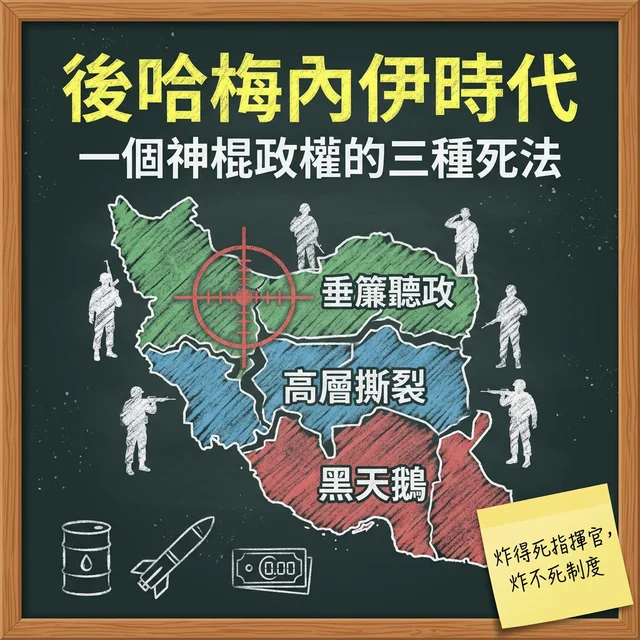
In my last piece, I wrote about slogans and missiles: a regime that chanted "Death to America" for 47 years finally had missiles arrive — and the people stood on the side of the bombs, cheering. That article answered "who did the slogans protect?" This one tackles a bigger question: Khamenei is dead. Then what?
The street fireworks and the dancing videos going viral on Starlink were covered last time. What matters is the silent morning after the fireworks fade. Ninety-two million Iranians open their eyes to find the world no different from yesterday. The rial is still worthless. The Revolutionary Guards' guns are still there — only the hand on the trigger has changed. The question is: whose hand?
Live Autopsy
On the morning of February 28, 2026, the United States and Israel launched the most precisely targeted decapitation strike against a single nation's leadership since World War II. B-2 stealth bombers from the 509th Bomb Wing carried 30,000-pound GBU-57 bunker busters and 2,000-pound precision-guided munitions, dropping up to 30 ordnance in broad daylight on Khamenei's residence and administrative complex in central Tehran. Sixty seconds. From over 1,600 kilometers outside Israeli airspace, hitting near-simultaneously. Airbus and Vantor satellite imagery subsequently confirmed: the buildings were completely destroyed, thick black smoke columns rising from the rubble.
Trump released a video from Mar-a-Lago at 4 AM announcing Khamenei's death, then addressed the Iranian people directly: "Take over your government. This will be your only chance for generations."
Forty-eight senior Iranian leaders were eliminated in the same wave of bombing. Armed Forces Chief of General Staff Abdolrahim Mousavi, IRGC Ground Forces Commander Mohammad Pakpour, Defense Minister Aziz Nasirzadeh, Supreme Leader senior adviser Ali Shamkhani — even former president Mahmoud Ahmadinejad was reportedly killed. Khamenei's daughter, son-in-law, and grandchildren perished simultaneously. Iranian state television took nearly 20 hours to switch from "denial" to "confirmation," ultimately settling on one word: martyrdom.
This wasn't an assassination. It was a live autopsy. In a single morning, U.S.-Israeli forces gutted the entire top layer of the Islamic Republic's command chain. A theocratic machine that had operated for 47 years suddenly found its brain removed.
A Revolution That Overthrew a King Wants to Be King
Article 111 of Iran's constitution provides a contingency for the Supreme Leader's death: a transitional leadership council composed of the president, the chief justice, and a jurist from the Guardian Council, bridging to the selection of a new leader. On March 1, this three-person council officially activated: President Masoud Pezeshkian, Chief Justice Gholamhossein Mohseni Ejei, and Guardian Council jurist Alireza Arafi. Foreign Minister Abbas Araghchi immediately stated: state institutions are functioning normally, a new Supreme Leader would be chosen "within a day or two."
A day or two?
The body responsible for choosing the Supreme Leader is the 88-member Assembly of Experts, an electoral college of clerics. But the Motahari complex bombed by U.S.-Israeli forces was the Assembly's headquarters, and the number of surviving members remains unknown. A Middle East Forum analyst summed it up in one sentence: "When bombs are falling, the Assembly can't convene, octogenarians can't run fast, and they were too tempting a target to begin with." The real succession game isn't happening in meeting rooms — it's in the shadows.
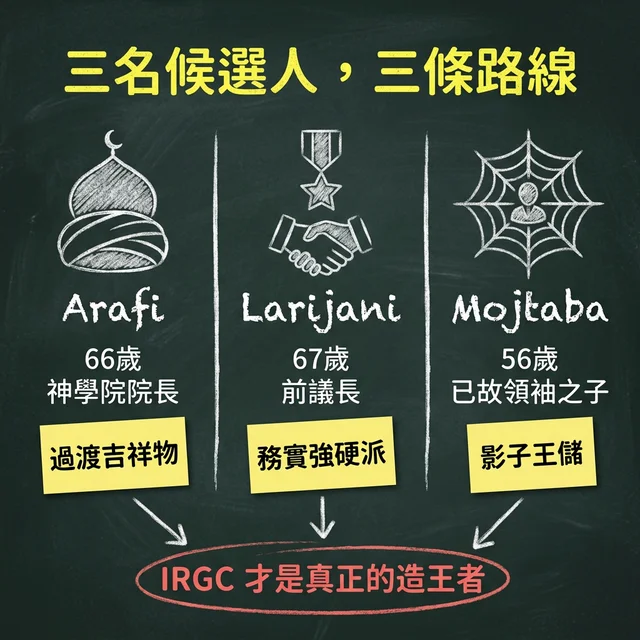
Three candidates, three paths. Alireza Arafi, 66, head of all Iranian seminaries, already seated on the transitional council. Impeccable religious credentials but weak in political and military power — more likely a symbolic transitional figure. Ali Larijani, 67, former Speaker of Parliament, former IRGC officer, with unverified intelligence suggesting Khamenei designated him as emergency successor days before the strike. A pragmatic hardliner who pushed the 25-year China-Iran cooperation agreement and maintains deep personal ties with Putin.
Then there's Mojtaba Khamenei, 56, the late Supreme Leader's second son.
Mojtaba's power base lies not in the seminaries, not in parliament, but deep within his father's secret office, the "Bayt." The Bayt is a coup-proofing machine, embedding a parallel control network throughout the nation's intelligence systems, security apparatus, military promotions, and economic conglomerates. Mojtaba sits at the center of this spider web, micro-managing the tension of every strand. The U.S. Treasury has flagged his name for allegedly transferring $1.5 billion out of the country. He oversaw domestic protest suppression operations. His binding depth with the IRGC and intelligence services means his power in the shadows may already exceed that of most political figures on the surface.
But Mojtaba has a fatal problem: the core slogan of the 1979 revolution was overthrowing the Pahlavi dynasty's hereditary rule. A revolution against monarchy has walked 47 years, only to arrive at a son inheriting his father's seat. Traditional clerics in Qom are vehemently opposed, calling it a fundamental betrayal of revolutionary spirit.
Marx said history always repeats itself — first as tragedy, then as farce. When Khomeini died in 1989, Khamenei himself was only a low-ranking Hojatolislam, not even meeting the threshold for Marja (source of religious authority). He publicly admitted in the Assembly of Experts: "An Islamic society where even someone like me can be nominated as leader should weep tears of blood." And the result? Rafsanjani claimed Khomeini had privately favored him, the constitution was amended to remove the Marja qualification, and Khamenei was overnight elevated to Grand Ayatollah — then ruled for 36 years. Political expediency overriding theological requirements — in the Islamic Republic, this isn't the exception. It's the tradition.
Now it's his son's turn. The tragedy has already played out once. Whether what follows is farce or an even greater tragedy depends on another player.
The Real Kingmaker
The Islamic Revolutionary Guard Corps (IRGC) is no longer an army.
Over the past two decades, the IRGC has quietly metamorphosed from a revolutionary praetorian guard into a military-industrial complex spanning energy, construction, telecommunications, and finance. It controls vast bonyads (charitable foundations) that are effectively underground economic empires beyond public oversight. It manages Iran's entire external proxy network, from Hezbollah in Lebanon to the Houthis in Yemen. When Khamenei was alive, the IRGC answered to him because he was the only person who simultaneously held constitutional authority and religious authority, maintaining the delicate balance of power between the clerical establishment and the generals.
_The Dictator's Handbook_ contains a line: "Those who can put a leader on the throne can also pull him off it." Khamenei spent 36 years cultivating the IRGC as his claws, but once claws grow to a certain size, they no longer need the master's permission to strike. Now the master is dead.
IRGC Commander Pakpour also died in the strike. Pakpour himself had only been appointed in June 2025 after his predecessor Hossein Salami was assassinated in the first round of airstrikes. Two commanders killed within a year, and the successor is Ahmad Vahidi — a hardline former defense minister wanted by Interpol for allegedly participating in the 1994 AMIA Jewish community center bombing in Argentina that killed 85 people. An international fugitive becoming the supreme commander of Iran's most powerful armed force — the image itself tells you where the system has gone.
The IRGC isn't monolithic internally either. Deputy coordinator Mohammad-Reza Naqdi was recently "silently dismissed," sparking rumors of infiltration and internal purges. The IRGC mouthpiece _Javan_ newspaper openly attacked the hardline "Steadfastness Front" (Jebhe Paydari), exposing factional rifts at the core. This isn't a wartime system united against external threats — it's a pack of predators sizing up each other's throats after the death of the den's master.
CFR (Council on Foreign Relations) analysts warn: the IRGC is the regime. You can use air power to destroy the top of the command chain, but you can't bomb out a military bureaucracy already deeply rooted in the economy's and society's capillaries. Achieving "regime change" requires a ground invasion. And the cost of a ground invasion is another Iraq War. Toppling Saddam took three weeks in 2003; the cost of managing the power vacuum is still bleeding today.
The Old Order Is Dead, the New Order Is Unborn
What did Khamenei leave behind?
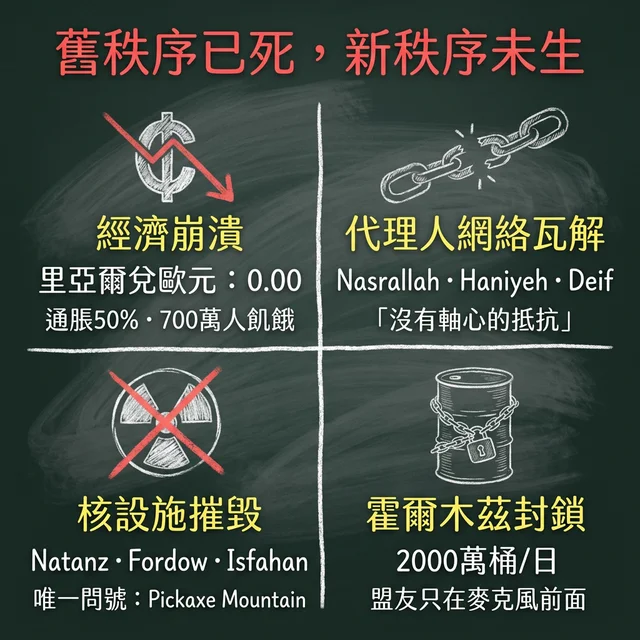
Economically, the Iranian rial has plunged to a historic low of 1.4 to 1.63 million per dollar. On some digital trading platforms, the rial-to-euro exchange rate displays "0.00" because the numbers are too small. Inflation exceeds 50%. The government just eliminated subsidized foreign exchange for basic imports; food prices are expected to rise another 20-30%. Meat has become a luxury. Water and electricity are rationed periodically. An estimated 7 million people face hunger. As for those shadow banking funds circumventing U.S. sanctions? They sit in offshore shell companies, specifically to fund proxy networks — domestic citizens don't see a single penny. In January, over 6,000 protesters marching against economic collapse were crushed; in late February, the same people celebrated their leader's death on the same streets. Forty-seven years of suppressed fury erupting — nobody needs to teach them when to laugh.
On the proxy network front, between 2024 and 2025, Israel's intelligence apparatus methodically dismantled Iran's decades-long "Axis of Resistance." Hezbollah's supreme leader Hassan Nasrallah, military commander Fouad Shukur, and likely successor Nabil Kaouk were assassinated in succession, leaving the organization in its weakest state in decades. Hamas lost Ismail Haniyeh, Saleh Arouri, and Mohammed Deif, devolving from an organized armed force into a localized insurgency. Chatham House used an apt phrase: "Resistance without an axis." Only Yemen's Houthis retain operational capability, pledging to escalate attacks on commercial shipping in the Red Sea.
On nuclear facilities, the June 2025 "Midnight Hammer" operation had already severely damaged the three core sites at Natanz, Fordow, and Isfahan. The second round in February 2026 further destroyed the Atomic Energy Organization headquarters and Parchin explosives research center. Fordow's 300-foot rock shield was penetrated by GBU-57 bunker busters. The only facility with unknown status is Pickaxe Mountain, an ultra-deep facility built within 80-100 meters of granite, specifically designed to withstand American bunker busters. This is the last question mark of Iran's nuclear program.
Globally, the IRGC announced via VHF radio a "de facto closure" of the Strait of Hormuz. This strait carries 20 million barrels of crude oil daily — one-fifth of global demand. Brent crude swung violently. Maersk suspended all routes, rerouting around the Cape of Good Hope. China's response was the most telling: cutting Iranian crude imports by 220,000 barrels per day while increasing Russian crude by 370,000 barrels per day. Wang Yi denounced "the law of the jungle" to Lavrov's face while already switching suppliers behind the scenes. Russia and China verbally supported Iran — Putin called it "cynical murder" — but neither expressed any willingness for military involvement. At the moment Iran needed allies most, it discovered that allies only exist in front of the UN Security Council microphone.
Three Ways to Die
How will Iran die? Or more precisely: in what form will the Islamic Republic survive?
History provides three templates. Ceaușescu's Romania: personality cult collapses, regime rapidly disintegrates. Gaddafi's Libya: dictator killed, nation descends into tribal warfare, still without a unified government. Saddam's Iraq: external overthrow is easy, managing the power vacuum is a disaster spanning two decades.
But Iran isn't entirely any of the above. Libya's state machinery was just Gaddafi alone — when he died, the state died with him. Saddam's Republican Guard was a praetorian force that could be defeated. The IRGC is not. The IRGC is a "state within a state" with its own business empire, its own intelligence system, its own diplomatic network. It's too big to bomb. You can kill its commanders, but you can't bomb an institution.
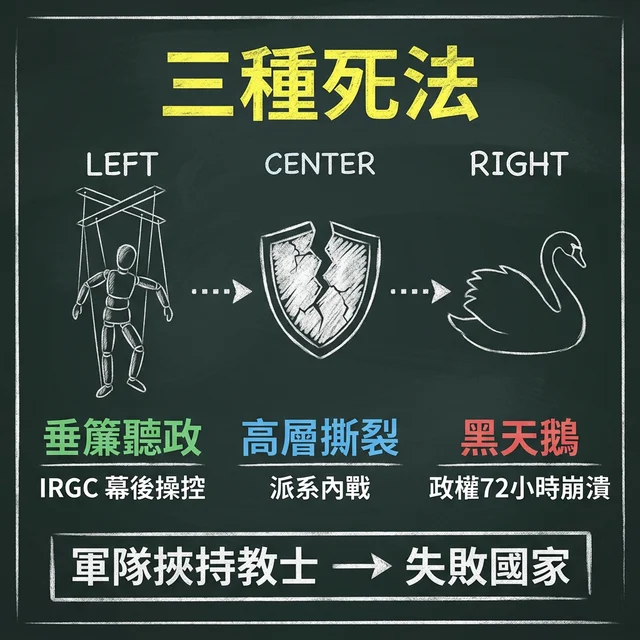
Three possible futures.
Puppet Rule. The most likely outcome. The IRGC orchestrates a "managed transition" behind the scenes, installing a weak cleric acceptable to all factions as Supreme Leader. This new leader's title is "Supreme Leader"; his actual role is "Supreme Mascot." The state machinery is taken over by IRGC generals under the pretext of "wartime emergency." The National Interest predicts: this will be an insider succession, with IRGC commanders playing both player and referee, producing a military dictatorship that retains the theocratic shell while discarding the theocratic substance. Iran won't become a democracy — it will transform from "clerics commanding the military" to "military hijacking the clerics." This is the most "stable" outcome, and the cruelest for the Iranian people: the oppressor changes face, but the oppression doesn't diminish one bit. Elite Fracture. The highest-risk scenario. Mojtaba forces hereditary succession; Qom's clerical establishment and internal IRGC opposition erupt simultaneously. The IRGC itself isn't unified — Naqdi's dismissal and Javan's open attacks have already exposed factional rifts. As the pie of interests rapidly shrinks due to intensified sanctions and war attrition, "revolutionary brothers" who worked together for 40 years will quickly become competitors tearing at each other's share. The Hudson Institute's assessment: Iran possesses the preconditions for revolutionary outbreak (economic collapse plus external isolation), but lacks an organized revolutionary leadership to assume power. A revolution without leadership isn't liberation — it's a prelude to civil war. Black Swan. Lowest probability, highest impact. Prolonged Hormuz blockade, oil revenue drops to zero, 7 million hungry people's patience reaches its limit. At that point, everything hinges on one question: will IRGC rank-and-file soldiers shoot their own compatriots? Ceaușescu died at precisely this moment in 1989 — the military refused to fire, and the regime collapsed within 72 hours. But destroying the central government of a nation of 92 million doesn't give you democracy. It gives you a failed state.Then What?
Tehran's fireworks have faded. Those who celebrated were celebrating one man's death, but the system that stole their breath for 47 years is still alive.
The IRGC hasn't disappeared with Khamenei's death — it's shedding its skin. The old shell is cracking; the new shell is hardening. Oman's mediation, ceasefire negotiations, U.N. Security Council condemnation statements — these are all background music. The real score determining Iran's future is being written in an IRGC command post in Tehran that won't appear on any map. The generals who control the guns, the money, and the intelligence network are deciding what the next "Supreme Leader" will be named — and whether that name is still worth printing on anything.
_The Dictator's Handbook_ author Bruce Bueno de Mesquita once wrote: "The ultimate lesson of politics is that the final purpose is to rule, not to govern well."
Khamenei is dead. The Islamic Republic's system hasn't died one bit.
_(Data sources: AP, Washington Post, Guardian, CFR, The National Interest, Hudson Institute, International Crisis Group, Chatham House, Iran International, Forbes, Times of Israel. Corrections welcome if any factual errors are found.)_
_—Kinney's Wonderland_