SpaceX's First Earnings Report: I Underestimated Growth—and Capital Spending
SpaceX's second-quarter revenue and earnings beat my forecasts by a wide margin, but capital spending reached $18.369 billion and free cash flow was roughly −$15.95 billion. Growth is stronger; the valuation remains expensive.
In my previous article, I forecast that SpaceX would report second-quarter revenue of $6.8 billion, an operating loss of $1.5 billion, adjusted EBITDA of $1.8 billion, capital spending of $12.5 billion and negative free cash flow of roughly $11 billion. I argued that even strong results would not justify the share price or offset the lock-up selling pressure.
The results are now in. I underestimated SpaceX's growth and profitability. I also underestimated the scale of its capital spending. The business is stronger than I expected. The shares are still expensive.
I Underestimated Growth—and Capital Spending
SpaceX reported second-quarter revenue of $7.814 billion, $1.014 billion above my forecast. The group recorded an operating loss of just $143 million, far below the $1.5 billion I expected. Adjusted EBITDA reached $3.538 billion, almost twice my forecast. Operating cash flow for the first half was $3.466 billion. After subtracting the first quarter's $1.047 billion, second-quarter operating cash flow was approximately $2.419 billion, above my $1.5 billion forecast.
Of the three segments, only Connectivity and Space came close to my estimates. Connectivity generated $4.291 billion of revenue, compared with my $4.3 billion forecast. Space generated $962 million, compared with my $1.0 billion forecast. The largest error was AI: actual revenue reached $2.561 billion, $1.061 billion above my estimate.
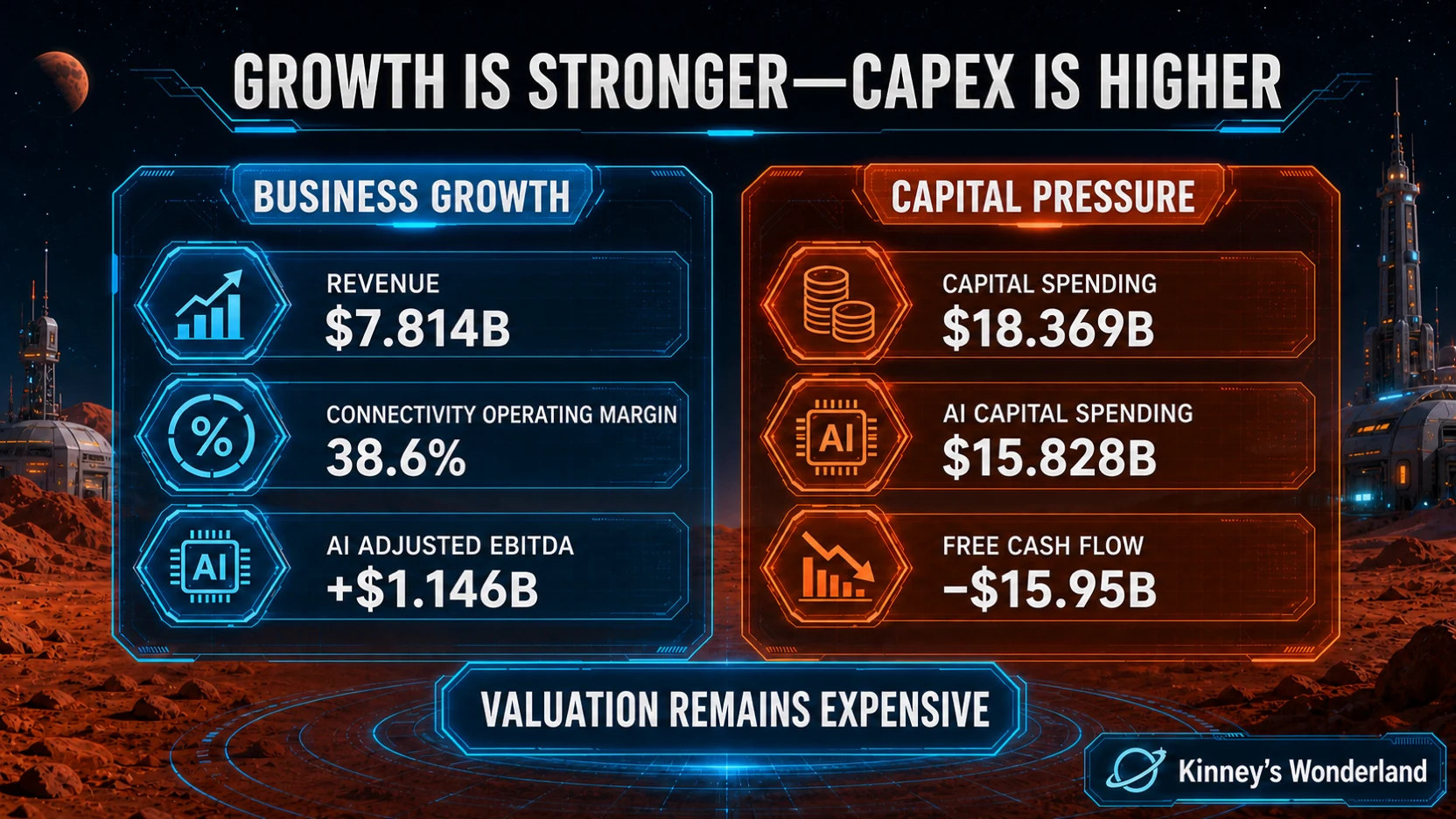
Second-quarter capital spending rose to $18.369 billion, $5.869 billion above my forecast. AI accounted for $15.828 billion. Subtracting capital spending from estimated second-quarter operating cash flow gives negative free cash flow of roughly $15.95 billion. That was $4.95 billion worse than my forecast.
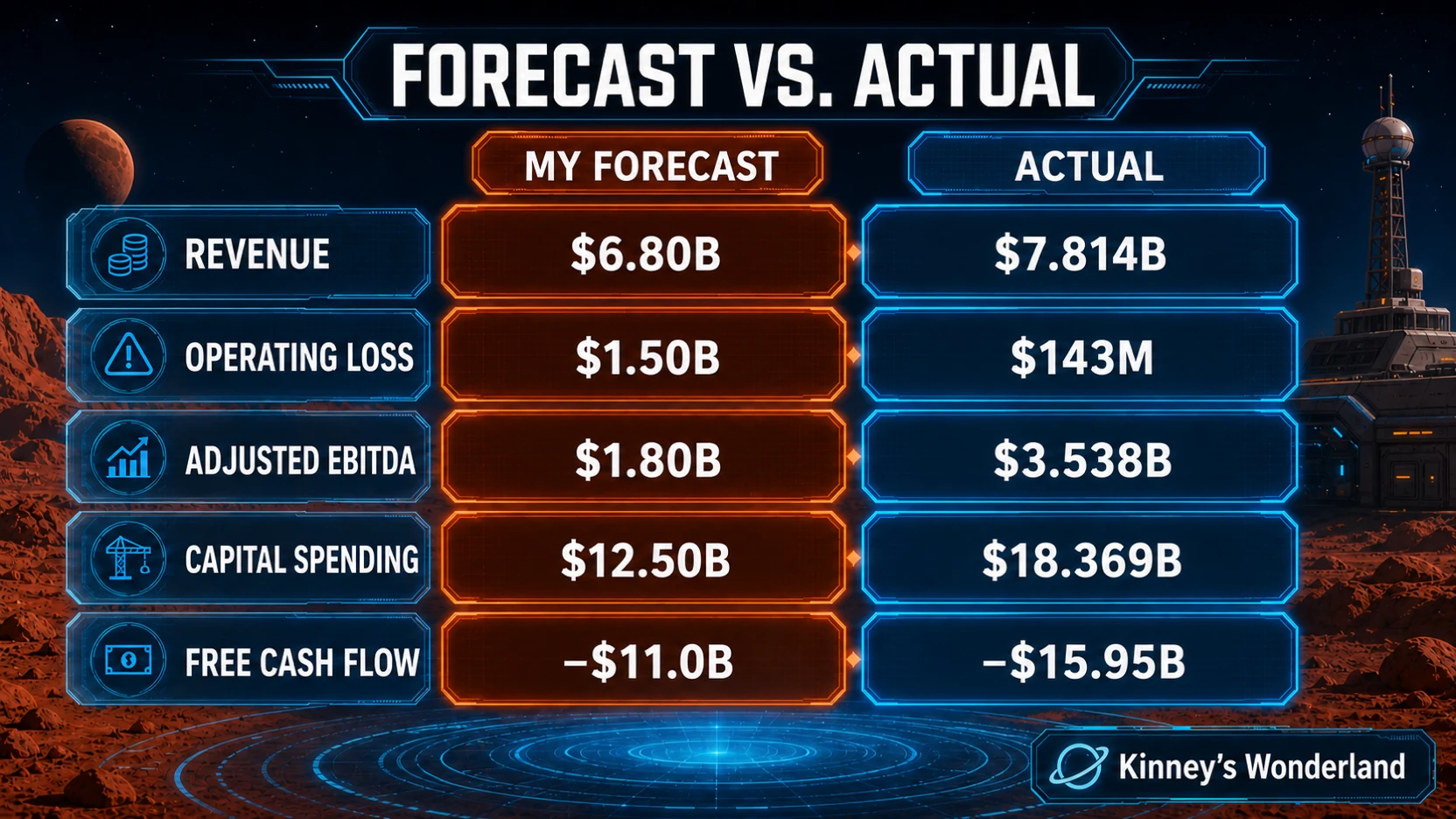
The central tension has not changed: profitability improved, but capital spending still far exceeded operating cash flow. Growth was stronger. Spending was also higher.
Starlink Has Passed the Test
Connectivity revenue grew 66% year over year. Operating profit reached $1.656 billion, for a margin of 38.6%—above the 38% threshold I had set for an optimistic outcome. Starlink's user base doubled from a year earlier to 12 million, while average monthly revenue per user held at $66, unchanged from the first quarter. Enterprise and government revenue increased 108%. Starlink has now shown that user growth can turn into profit.
AI also progressed faster than I expected. Revenue more than doubled from the previous quarter, while adjusted EBITDA swung from negative $609 million in the first quarter to positive $1.146 billion. SpaceX signed $14.1 billion of cloud-service contracts during the second quarter. Those contracts generated $1.6 billion of AI infrastructure revenue in the quarter. AI commercialisation is accelerating.
AI's adjusted EBITDA is now positive, but the segment still recorded a second-quarter operating loss of $1.257 billion, depreciation and amortisation of $1.885 billion, and capital spending of $15.828 billion. Space also recorded an operating loss of $542 million. Adjusted EBITDA does not include the cash spent on new equipment. It cannot substitute for free cash flow.
AI Investment Is Backed by Contracts—and Capital Spending Keeps Rising
CFO Bret Johnsen said third- and fourth-quarter capital spending would be similar to the second quarter. That implies full-year 2026 capital spending of roughly $65.2 billion. The company expects computing capacity to exceed 2 GW by year-end. Musk expects it to exceed 5 GW and approach 10 GW by the end of 2027. SpaceX has also decided to use Nvidia systems exclusively.
Management said the new AI equipment could recoup its cost in less than a year. In the first few weeks of the third quarter, the company signed another $6.7 billion of cloud-service contracts. The contracts run for six months, with revenue recognition beginning in October. Management expects the annualised revenue run rate based on December revenue to exceed $100 billion, with cloud services as the largest source of growth.
These contracts have changed how I view capital spending. SpaceX has orders in hand, and the new equipment is backed by real demand. However, management did not explain the basis of its claim that the equipment could recoup its cost in less than a year. The $100 billion figure is an annualised run rate based on December revenue, not expected full-year 2026 revenue, and it includes the pending acquisition of Cursor. The next test is whether the contracts produce revenue and cash on schedule.
Earnings Beat Expectations; the Valuation Is Still Expensive
SPCX closed at $125.33 before the results, giving the company a market capitalisation of roughly $1.65 trillion. Even after annualising second-quarter revenue to $31.256 billion, the price-to-sales ratio was still about 53 times. The shares fell more than 8% after hours following the release. Growth beat expectations, but it was not enough to remove the valuation pressure.
My original fair-value range of $70 to $85 was based on a 2026 revenue estimate of $27 billion to $30 billion. The second-quarter result and the latest contracts show that estimate was too low, so the old range must be recalculated. There is not yet enough information to set a new range. There is also no reason to treat $115 to $125 as reasonable simply because the old estimate was wrong. The current price already assumes that Starlink, AI and Starship will all succeed.
SpaceX's business is better than I expected. I still consider SPCX overvalued at the current price. To change that view, I need to see the new $6.7 billion in contracts start producing revenue and cash as planned in the fourth quarter, AI's operating loss continue to narrow, capital spending remain within guidance, and accounts receivable stop growing faster than revenue.
The Final Test Is Still Pending
On 6 August, up to 911.5 million shares become eligible for sale. That is the maximum eligible amount, not a forecast that every holder will sell. To pass the lock-up test, SpaceX must attract enough buyers to absorb the additional supply over the following several days.
SpaceX has passed the growth and profitability tests, and operating cash flow improved. It has not yet passed the free-cash-flow or valuation tests, while the lock-up result remains unknown. More ambitious targets from Musk cannot substitute for actual cash flow. I will change my view only when the AI contracts begin to generate cash and the market proves that it can absorb the lock-up shares.
常見問題 FAQ
Did SpaceX's second-quarter results beat expectations?
Yes. SpaceX reported second-quarter revenue of $7.814 billion and adjusted EBITDA of $3.538 billion, both well above my forecasts of $6.8 billion and $1.8 billion. The group's operating loss was just $143 million, far below the $1.5 billion I expected.
Is Starlink profitable now?
Yes. Connectivity generated second-quarter operating profit of $1.656 billion, for a margin of 38.6%. Its user base doubled from a year earlier to 12 million, showing that Starlink's user growth is translating into profit.
If SPCX delivered strong results, why is the valuation still expensive?
Before the results, SPCX had a market capitalisation of roughly $1.65 trillion. Even after annualising second-quarter revenue, the price-to-sales ratio was still about 53 times. Second-quarter capital spending reached $18.369 billion, while free cash flow was roughly −$15.95 billion. The current valuation still depends on Starlink, AI and Starship all succeeding.